LOST LETTERS OF MEDIEVAL LIFE
Tuesday, February 24, 2015
REVIEW OF LOST LETTERS OF MEDIEVAL LIFE.
For my February turn on The History Girls I have reviewed this marvellous book by historians Martha Carlin and David Crouch. Well worth reading.
LOST LETTERS OF MEDIEVAL LIFE
Thursday, January 29, 2015
A CASE OF MISTAKEN IDENTITY? Perhaps and perhaps not: A reply to Catherine Armstrong's essay on the Marshal Effigies.
![]() |
| Photo Elizabeth Chadwick |
I wrote to Catherine setting out my case for disagreeing with her on the issue of the arms and armour some years ago, and received a thank you note, but nothing more. I've been intending to write out my refutation argument and put it in the public arena for several years now, and I have finally got around to it.
Here is Catherine's highly detailed article. Catherine Armstrong on the Marshal Effigies I must emphasise I don't disagree with her on the point that these effigies cannot be identified with absolute conviction and I applaud her diligent research into the life of the effigies before the 21st century. That in itself is a fascinating, wonderful and sometimes horrifying story!
I do, however, vigorously disagree with her on the issue of the dating of the arms and armour for which I can make a strong case. I also believe I can make a good case for identifying the effigy of Gilbert Marshal despite lack of written evidence.
Catherine Armstrong uses engravings of the Marshals by Edward Richardson to state her case. The work was published in 1843. So it's good to look back to a historical context a hundred and seventy years closer to the construction of the effigies, but at the same time we are relying on engravings, and also with the knowledge that Victorian antiquarians were extremely inquisitive but not always on the ball with their historical accuracy. You can read the book here for free. Edward Richardson Temple Church Effigies
Catherine's argument is that the effigy of William Marshal I cannot be him since it is older in the style of armour than the ones purporting to be his sons.
Catherine says of the effigy below, now thought (erronously or not) to be William Marshal Junior (died 1231) "The effigy was described by Richardson as wearing a chain mail coif and a hauberk of chain mail to his knees. However he is wearing what appears to be chausses of leather or some reinforced material from his waist to just below his knees. Lankester describes this covering as possibly gamboised cuisses which were quilted tube-like padded armour worn to protect the thighs, but they are show without covering of full chain mail which would have been the usual practice."
| Richardson's effigy engraving of the effigy now known as William Marshal's son William II |
Before anyone protests that Robert Curthose died in the early 12th century, let me say this is an effigy created in the 13th century and not at the time of Robert's death, so it's in the style of that later time.
![]() |
| photo credit Nilfanion Wikipedia |
.
.
This guy prefers his cuisses. He dates to 1250
And here's Thomas Becket being murdered from a manuscript dating to circa 1200. British Library. Mail chausses again on the far left knight.
| photo Elizabeth Chadwick |
.
![]() |
| Apocalypse. British Library 1270's |
Above we have an apocalypse scene from the British library and the knight on the horse is sporting cuisses. Dateline 1270's.
![]() |
| Westminster Psalter circa 1250 Another knight wearing Cuisses - drawn by Matthew Paris. Wikipedia |
Above we have an interesting one dating to 1230, 11 years after the Marshal's death and one year before the death of his eldest son. Here you can see the transition kite versus the shorter shield and the knight with the transition is wearing a mail glove. Both men are wearing mail chausses without visible cuisses and are a prime example of the ongoing changing interface of military styles taking place in the early to mid 13th century.
![]() |
| Knight from Wells Cathedral circa 1230. Mail chausses, no cuisses By kind permission of Paul F. Walker, author of The History of Armour 1100-1700. |
![]() |
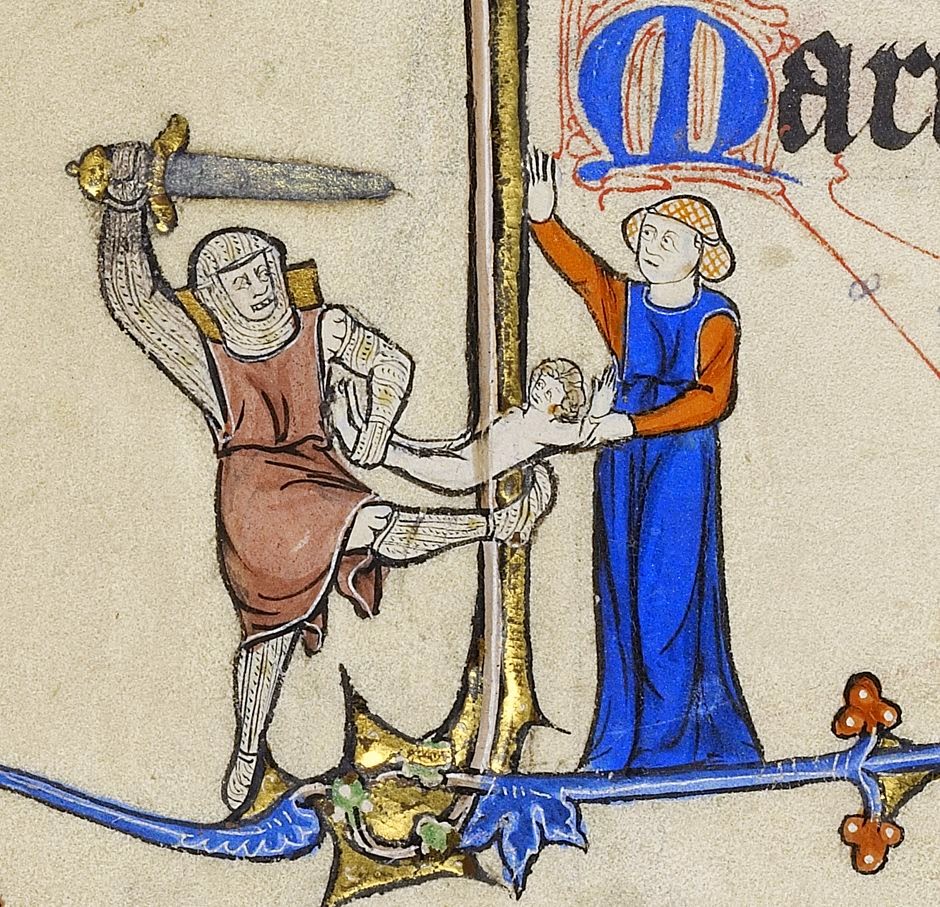
| Cuisses dated to c1300. An Innocent being massacred from The Ruskin Hours France. Los Angeles. The J. Paul Getty Museum. Ms. Ludwig IX 3 fol. 85v |
| photo Elizabeth Chadwick |
Catherine Armstrong tells us that on the William II effigy the guard on the sword is relatively small and not as wide and visible as on the other effigies.
Yes. That would be because the ends have broken off... - see further down for evidence of it happening to Gilbert's effigy.
Catherine comments that smaller guards appear on the seals of Robert FitzWalter and Richard the Lionheart but swords had long lives and forty years isn't a hill of beans anyway in terms of that particular style. It's only a minor point though. The chausses/cuisses question immediately tells us we are probably dealing with mid 13thc, especially when combined with other details. The shield for example. If you look at the effigy purporting to be William Marshal I, his shield is of an older style that had gone out by the mid 13th. It's a shield in the process of transitioning from the old style kite shield into the smaller triangular shield but not there yet and a massively telling detail. The William II and Gilbert Marshal effigies both have the new style of smaller shield. Indeed the Gilbert effigy has them in decoration on his baldric strap. You can see the older transition kite in the 1200 illustration above of Becket's murder. Add the shield style to the leg fitments and the more raised style of the William Junior and Gilbert effigies and it's as clear as daylight that the William I effigy is older.
![]() |
| photo Carole Blake |
| Photo Elizabeth Chadwick |
Now to the matter of Gilbert Marshal's scallop shell sword. This is one of the identifiers that tell me this is likely to be Gilbert.
| Photo Elizabeth Chadwick |
Catherine Armstrong observes that she has 'found no record that states that Gilbert Marshal made a pilgrimage to St James de Compostella (scallop shell was a symbol of such a pilgrimage) or that a scallop shell was any part of his coat of arms, She says it's an unusual design and basically we should be looking for someone other than Gilbert Marshal to be wielding it.
However, sword expert Ewart Oakeshott tells us that it's a common design in the North of England in the mid 13thc and there has actually been a find of one at Cartmel - and who were the patrons of Cartmel Priory? Yep, the Marshals. It's nothing to do with Compostella. And note that the sword guard has broken off re the comment on short guards.
![]() |
| Wikipedia |
Here's Gilbert Marshal suffering his fatal accident at a tournament when his reins were cut by his enemies and his foot caught in his stirrup and he was dragged to his death. Note the sword hilt. Not exactly the same, but a darned good approximation for a chronicler. So we have circumstantial ID that this effigy IS Gilbert Marshal. On this illustration he's wearing full mail on his legs, demonstrating the overlap of armour styles. One size doesn't fit all.
What further nails the identity of this particular effigy as Gilbert Marshal is that the serpent he is trampling, the symbol of evil, is actually chewing on his spur strap. I was told by a guide at the Temple Church that this was a comment on the way he had died. Add in the sword hilt and the style of the armour and circumstantially we have our man. It is highly likely that the effigy of William II was carved by the same hand, so for my money it's very possible that we are looking at the two Marshal brothers William II and Gilbert.
| Richardson - Google Books |
Richardson's engraving of Gilbert Marshal. As you can see the sword had more of its guard when this was made in the mid 19th century compared to now (see my photo above of the scallop shell hilt). The same has happened to William II's guard. They're not shorter, they're just broken off.
| Spur strap munching serpent. Photo Elizabeth Chadwick |
Catherine Armstrong makes the point that the William Marshal I effigy is wearing mailed gloves which are of a later date than mail mittens. However, mail mittens continue well into the 14th century. Nicolle opines that gloves are late 13th, but that they were being used in Byzantium much earlier. So it's not beyond the scope of reason that if William adopted crusader designs when remodelling his castles, he also may have returned from the Holy Land with mail gloves too. The illustration of the fighting knights above shows what looks like a mail glove dating to 1230. Or it could just be a stylistic conceit on the tomb and illustration aimed at showing the shape of his hand around the sword grip.
Conclusion: While it is impossible to say whether these are the effigies of William Marshal and his sons William and Gilbert it becomes very clear that we can say:
1. The effigy claimed as that of William Marshal I is older than the other two in terms of armour style and of overall effigy type (it's not as raised, it doesn't have the vigour that came in later or the finesse. It has an older style shield and tried and tested mail chausses that had been around for most of the 12th century as opposed to the cuisses which didn't arrive until later). Historian H.A. Tummers considers that the 'lively martial attitude' of effigies (such as Robert Curthose and the Marshal sons) was a 'limited late development.' i.e. well into the 13thc. So the William I effigy is of the right dateline to have been created circa the time of William Marshal's death.
2. Of the two effigies purported to be the sons, there is at least circumstantial evidence that the one with the scallop shaped sword hilt and the serpent attacking his spur strap is, in fact Gilbert Marshal.
I do hope that Catherine Armstrong will reconsider her essay in the light of this information.
Thank you
Elizabeth Chadwick.
| Close up of the face of 'the effigy known as William Marshal II Photo Elizabeth Chadwick |
Medieval Warfare Source Book vol 1 by David Nicolle 1995
The Sword in the Age of Chivalry by Ewart Oakeshott - Boydell revised 1994
Wednesday, December 24, 2014
MAGNA CARTA by Dan Jones. My review for The History Girls.
I've just reviewed Dan Jones' book MAGNA CARTA for The History Girls. Here's the url. I thought the book was excellent and would recommend it for anyone's bookshelf. My review of Magna Carta by Dan Jones
Tuesday, December 23, 2014
IF IT'S CHRISTMAS IT'S CHINON: The festive itinerary of Henry II.
I post over at THE HISTORY GIRLS blog on the 24th of every month. I thought I'd give you all a link to a blog post I wrote for them last Christmas eve about King Henry II and his whereabouts on every Christmas of his reign. IF IT'S CHRISTMAS IT MUST BE CHINON
Labels:
12th century.,
Chinon,
Christmas,
Henry II
Monday, October 06, 2014
INVENTING ELEANOR By Michael R. Evans: My thoughts.
Inventing Eleanor: the mediaeval and post-mediaeval image
Eleanor of Aquitaine by Michael R. Evans.
Bloomsbury Academic ISBN 978 1 4411 6900 6
While browsing the Internet for research, I came across a
reference to this book and feeling it would be a really useful addition to my
shelves, I went ahead and bought it.
During my research into
Eleanor of Aquitaine, I constantly come across misconceptions and false
information in secondary sources including biographies. I also come across comments about Eleanor being a great feminist icon and a woman way ahead
of her time, and then I want to bang my head on the desk
(metaphorically speaking). So it was
great to come across a work that aims to set the record straight and that tells
us just where these odd notions about Eleanor originate.
From the back of the book:
‘Eleanor of Aquitaine (1124- 1204)
Queen of France and England and mother of two Kings has often been described as
one of the most remarkable women of the Middle Ages. Yet her real achievements
have been embellished - and even obscured - by myths that have grown up over
eight centuries. This process began in her own lifetime, as chroniclers
reported rumours of scandalous conduct
on crusade, and has continued ever since. She has been variously viewed as an
adulterous queen, a monstrous mother and jealous murderess, but also was a
patron of literature, champion of courtly love and proto-feminist defender of
women’s rights. Inventing Eleanor
interrogates the myths that have grown up around the figure of Eleanor of
Aquitaine and investigates how and why historians and artists have invented an
Eleanor who is very different from the 12th century queen. The book
first considers the mediaeval primary sources and then proceeds to trace the post-mediaeval
development of the image of Eleanor, from demonic Queen to feminist icon, in
historiography and the broader culture.’
This is exactly what the book does in a very readable form that
still remains scholarly and detailed in its sources. The
contents include an introduction where the author sets out his reasons for
writing the book and argues that she was ‘far
from unique amongst 12th century royal and noble women.’ Professor
Evans seeks to unravel how she acquired her reputation for exceptionalism. He remarks
on the opening page that Eleanor’s biographers
must take some of the blame for this. ‘In
the absence of hard evidence (these) biographies have often been fleshed out by
speculation and the creation or perpetuation of myths.’
Following a detailed introduction, Professor Evans traces
Eleanor’s reputation, through the blackening of her name during her own
lifetime and the time soon after her death.
He explores too the legends surrounding Rosamond de Clifford and how
both women’s reputations have suffered at the hands of myth and legend.
Chapter 2 looks at Eleanor in historiography and how
realistically she is portrayed. He observes that ‘historians may have striven to create (in the words of Edmond-René
Labande) ‘a realistic image of Eleanor of Aquitaine’, but that image has
struggled to replace that of the more colourful meta-Eleanor in the public
consciousness. Hence an online author in 2013 is still able to write of Eleanor
in stereotypical terms that would have been familiar to a mid-19th-century
readership of popular history.’ He
goes on to explore the way in which Eleanor’s reputation has been distorted to
suit the ideologies of particular historical periods and historians with axes
to grind. So ‘In the late 20th
century, second wave feminist movement gave birth to a new interest in Eleanor
of Aquitaine as a female hero, but often at the expense of exaggerating her
deeds and influence, and reinforcing the myth of her exceptionalism.’ He also explores Eleanor’s depiction as a
new-age neopagan type! He comes the
conclusion that ‘historians of Eleanor
have created an image of her, and mediaeval women as a whole, that is
misleading. My thoughts exactly.
The third chapter deals with Eleanor the woman of the South
and very quickly puts paid to the notion of the original Eleanor as
propitiating a great Southern cause. He
says that Eleanor is ‘arguably a northern
as much as a southern figure…It was
Poitou, not the south-west that was the heartland of Eleanor’s realm and where
the Dukes of Aquitaine held the greatest concentration of demesne lands.’ …. He also explores a suggestion from a
recent set of essays about Eleanor that claims she didn’t actually speak Occitan at all. The courts of love and literary patronage are
shown to be relatively insignificant in Eleanor’s life. He comes to the
conclusion that Eleanor of Aquitaine ‘can
in no way be considered a southern figure in an alien and hostile northern
world. Her native duchy straddled the divide between the North and the South,
and its main power centres were closer to Paris than to the Mediterranean.’ Bam, another dearly held myth bites the dust.
The next chapter deals with Eleanor’s portrayal in drama before
1900 and goes into great detail via Shakespeare, operas and sundry plays and
dramas. From there it’s onto Eleanor in drama post-1900, and of course the iconic
Lion in Winter. TV series such as Robin of Sherwood also receive a mention for how
Eleanor is portrayed in cameo roles.
Professor Evans then takes an overview of how Eleanor is
portrayed in fiction and there is a fine accolade for author Sharon Kay Penman.
Jean Plaidy’s take on Eleanor is discussed too and there are some ‘interesting’
quotes from Alison Weir’s the captive Queen. There’s also a section on Eleanor in young adult
fiction.
Then it’s onto Eleanor in the visual arts including
mediaeval images. This was particularly interesting for me because Professor
Evans discusses the mural at Chinon that is often said to portray Eleanor and
Henry. Indeed many novels and biographies feature this portrait on the cover
with the middle crown figure depicted as Eleanor. However, it ain’t necessarily
so, and it seems,according to art historian Ursula Nielgen who
has examined the work in detail and dated it to the late 12th century that the figures are all male and more likely to represent Henry II and his four sons. I was also pleased in this section to find that Evans had picked up my research on various
biographer’s beliefs on Eleanor’s appearance and I receive a mention at the
beginning of the chapter.
Having thoroughly explored Eleanor in the visual arts, right
up to modern ‘headless’ covers in historical fiction, Professor Evans goes on to
make his conclusion, which is basically that finding the real Eleanor remains
an uphill struggle because of all the myths perpetuated. However, with
continuing scholarship that doesn’t pander to these myths and stereotypes we
may gradually begin to see a more nuanced Eleanor than of yore.
During his summary he
remarked that while historians may shake their heads at the likes of certain recent
works of historical fiction about Eleanor, ‘historical novelists such as Sharon
Kay Penman and Elizabeth Chadwick are seeking to apply modern scholarship to
their fiction, and consequently avoid the most egregious of the legends
surround Eleanor.’ That’s nice!
Highly recommended for those who want to take a look under
the surface and who are prepared with an open mind to have their perceptions
and preconceptions challenged.
I would add that it is rather expensive - which seems to be the case with most academic books these days.
Tuesday, September 30, 2014
HISTORY GIRLS COMPETITION TO WIN A COPY OF THE WINTER CROWN
Just a note to say that THE HISTORY GIRLS blog where I post once a month is running a competition, open internationally, to win a copy of THE WINTER CROWN. Ends October 7th
Here are links to a couple of recent reviews of the novel:
http://forwinternights.wordpress.com/2014/09/10/the-winter-crown-by-elizabeth-chadwick/
Go here to enter the competition - it's international!
Friday, September 05, 2014
THE HISTORICAL NOVEL SOCIETY INDIE FICTION AWARD 2014
SO THERE I WAS back in July, minding my own business at a writers' event bringing together both Indie and traditionally published authors when my excellent friend and fellow speaker Helen Hollick drew me aside for a gentle little chat. She explained that she was organising an award to celebrate, recognise, and encourage the best of independently published historical fiction through the auspices of the Historical Novel Society of which we were both long-standing members.
Helen co-ordinates the online editorial reviews for Indie historical fiction, the best of which are awarded an 'Editor's Choice' accolade. Books receiving this accolade are automatically forwarded onto a longlist for the the award. Orna Ross, founder of The Alliance of Independent Authors had very generously offered a prize for the award winner and runner up and had agreed to read the longlist of selected novels and whittle them down to a final four. More details of how it works here
Helen twisted my arm asked me I would read the final four and choose a winner and a runner up. Now, those of you who know the, kind, enthusiastic and generous Helen Hollick, also know she is a force to be reckoned with when she wants something and that her lovely nature is only one facet. She outdoes John Wayne for true grit and bloody minded determination when she wants to get something done.
Somehow I found myself agreeing to read the shortlist, and then wondering just what I'd let myself in for.
I soon discovered that what I had let myself in for were four wonderful meaty reads, all very different that whisked me away to other times and places with such skill and involvement that while reading them, I was lost to the here and now.
But how to choose a winner. Helen told me that I should take presentation into account because that's one of the steep learning curves for an Indie writer to face. You can't just write the words onto a PC and then let the publisher do the rest. You are own publisher, marketing director and Public relations person. To stand a chance in an overcrowded market your work has to be presented both inside and out in a thoroughly professional way.
All of the novels were of a high standard in this department. Some could have been tweaked, but truly they were only nitpicks.
I organised a score sheet with 5 marks for the cover and another 5 marks for the internal presentation. Then scores out of 10 for historical feel, characterisation, plot, language and pace. So, a total of 60 marks.
I am an avid reader and this is how I looked at these four novels. As a keen reader rather than an academic literary critic. What I wanted was something that absorbed me so completely that I couldn't put it down. I wanted the sustenance of a superb story that would transport me to another time, make me think, create wonderful paintings in my mind and keep me turning the pages until the last one, where I would feel sorry it was over but satisfied too, and most importantly for the author, make me want to dash out and buy everything else he or she had written. I love books. As a reader I don't care whether they are Indie or mainstream. Just give me the story already and the words to make me live with your characters.
All of the novels had some of this element and I loved reading them, but when it boiled down to it, there was one outright winner, even though the second place gave it a run for its money.
I must add the caveat that I am only one person and others may disagree with me. It does come down to what each individual reader enjoys too, but since I was the individual asked to judge the contest this year, this is my choice.
THE WINNER OF THE 2014 HISTORICAL NOVEL SOCIETY INDIE AWARD GOES TO:
VIRGINIA COX for THE SUBTLEST SOUL.
The novel is set in Italy at the time of the Borgias and is based in part of events in Machiavelli's Prince. Indeed, Machiavelli has a cameo role in the novel as does Leonardo da Vinci. It tells the story of Matteo de Fermo, a young man struggling to survive into the violent world of the closing years of 15th century Italy.
Matteo's story is told with pace, panache and many intriguing twists and turns that are complex without ever being convoluted. The history felt real and right. It was an immersive experience. It was one of those books where I needed to know what happened next and kept having to go back and pick at it - you know like when you have that opened bar of chocolate in the fridge! How does he get out of this scrape? Oh my goodness, what's he doing now! I don't believe what just happened! The characterisation was stunning. It was a fairly long book at 450 pages, but they flew past and although it's a pity the author's name isn't on the book's spine, the internal layout and font size made it the easiest on the eyes of all the shortlisted novels.
I was also a little bit frustrated when it ended - like eating that last piece of chocolate. I now need to go out and get another bar. I sincerely hope that Virginia Cox is writing a sequel, and I shall be waiting in line to buy it!
RUNNER UP: A GIFT FOR THE MAGUS by LINDA PROUD
Before anyone says that I must have a fan thing for Renaissance Italy - I don't! Honestly I don't! It's just that the winner and runner up happen by coincidence to be set in 15thC Italy with A Gift For The Magus beings set a little earlier than The Subtlest Soul.
This is the tale of the notorious Fra Filippo Lippi, an artistic friar of supreme talent and dubious morals. His mistress, a nun and the mother of his children, was the model he used for the Virgin Mary. I knew nothing of Lippi's paintings before I read A Gift for the Magus but by the end of the novel I was eager to go exploring and discover his work. I loved the humour in the novel and the scenes of everyday life that put me right there in the heart of Padua and Florence, in the household of the Medici, in nunnery, chapel and hovel. I learned a great deal about Renaissance art, and I came to be very fond of Fra Lippi, his eccentricities and human failings, and his genius.
SAMOA By ROBERT SCHAFFER
and THE JACOBITE'S APPRENTICE By DAVID EBSWORTH
were also very worthy shortlistees (mentioned here only as they enter my brain and not as 3rd and 4th, but as equals) I loved the Mitchener-esque scope of Samoa and some of the descriptive language was breathtaking.
I enjoyed the coloured maps and the illustrations too and found them very useful for getting around in the novel. The sense of history in The Jacobite's Apprentice was palpable and it was useful to have a glossary to refer to at the back. It's told in first person present tense which gives it a strong sense of the here and now too, even though the characters are magnificently of their time. The book was also very professionally produced.
All opinions are obviously my own but I hope readers will take a chance on these books and enjoy the stories they have to tell. Congratulations to all four authors, but especially to Virginia Cox.
And a thank you too to Helen Hollick for asking me to read the shortlist. I may have thought about running away at the outset, but at some point over the course of the conference I am going to hug her!
Subscribe to:
Posts (Atom)


%2Bof%2BP1010004%2B-%2BCopy.jpg)


