King Henry I is notorious among English royalty for siring at least 20 illegitimate children. He produced only two legitimate offspring with his first wife Edith (Matilda) of Scotland, Matilda and William, the latter drowning on the White Ship while still in his teens. Perhaps Edith's routine habit of kissing leper's feet might have have something to do with the statistic! Henry is said by one chronicler to have been a slave to his lust. Another exonerated him by saying that he only indulged because he liked children! I have always thought that he was a man with a high sex drive who saw the by-product of his flings as an extremely useful political tool. Nothing like making marriage alliances and affinities with your sons and daughters.
So, who were the bastard children of Henry I? How many can be named? The below is taken from a chart in Judith A. Green's biography of Henry I
Not in chronological order:
Robert Earl of Gloucester - mother's name unknown
Richard - mother's name Ansfrida
Fulk - mother the same as Richard
Juliana - mother the same as the 2 above. Juliana married Eustace of Breteuil.
Reginald Earl of Cornwall - mother's name Sibyl
Robert - mother's name Ede
Gilbert - mother's name unknown, but the sister of Walter de Gant
William de Tracy - mother's name unknown
Henry - mother's name Nest (slight speculation)
Sibyl queen of Scots - mother's name unknown
William - brother of above Sibyl
Matilda Countess of Perche - mother's name Edith
Matilda - mother's name uknown. Married Alain Fergant Count of Brittany
Mabel - mother's name unknown. Married William Gouet
Constance - mother's name unknown. Married Roscelin of Beaumont sur Sarthe
Aline - mother's name unknown. Married Matthew de Genevieve Montgomery
Isabel - mother's name Isabel de Beaumont, sister of Waleran and Robert de Beaumont.
Matilda Abbess of Montvilliers - mother's name unknown
Emma - mother's name unknown. Married Guy de Marie Laval
Daughter - name and mother unknown. Married Fergus of Galloway.
Today's research photo: This is a finger ring belonging to Maurice de Sully, Bishop of Paris from 1160 - 1196
Today's research snippet. Taken from the Histoire de Guillaume le Mareschal. William has his horse stolen and exacts punishment on the thief. Some interesting details of social life on the tourney circuit.
The high-ranking men who had gone to the tournament were lodged throughout the town. It is the custom that in the evening they go and visit one another at their lodgings; this is a fine custom, and their conduct is courteous and polite when they seek to talk together, get to know one another and acquaint one another with the affairs which each has in hand. The Marshal. who was polite and behaved reasonably and did not put on airs, rode to the lodgings of Count Theobald on a tall and valuable horse, but he had not taken with him anyone to take care of it. He noticed at young lad standing with the rabble of onlookers and gave him his horse to look after. The Marshall dismounted and the young lad mounted. When the Marshall went inside, he was received with great joy by many...
While William was busy inside drinking and socialising...a scoundrel of a man, a man in the habit of stealing and who had seen the Marshal when he was dismounting, approached the lad now sitting on the horse. He grasped the hair round his forehead, pulled him down, and dealt him such a savage blow that he cried out at the top of his voice: "Help! Marshal, Marshal! this man here is taking your horse from me."
When the Marshal heard this, I can tell you that he was not in the least amused. Indeed, without taking his leave, he leapt to his feet; he had no wish to wait for any man and he arrived at the spot where he had left the horse. The thief was riding at full gallop away down the street, but you could not see a thing for it was very dark at night. However, the horse made a huge clatter on the hard paving stones. The Marshal was very quick and set off to follow the road, but on his own, for it was impossible to see a thing. The scoundrel turned aside, into another street, because the road stones were very hard. In the shadow of a cart full of branches, standing in front of an oven, the thief hid to prepare for an eventual escape. Since the horse was now standing still, and the Marshal could no longer hear the noise, he did not know where to go nor what to do. As he walked on, thinking on these matters, the horse started stamping its foot, although very gently. The Marshal made in its direction. Without making much noise, but gently and quietly, he went up to the horse, which whinnied.the scoundrel bent down and made to slip off the saddle, but the Marshal dealt him a blow with a piece of wood so violently across the eyebrows that never after that did he blink that eye again, for it flew right out of his head. A just reward fitting the crime committed!
'Have mercy, my Lord!' he said, 'I am dead!'
'It was not I who took it upon myself to use force against you this day,' was the Marshal's instant reply, 'You did it all by yourself.'
The count and those who were indoors with him ran after the Marshall, each vying with the other, none holding back, but they were unable to catch up with him until he had captured the scoundrel. They had great esteem for his speed, his agility, and had high praise for his prowess. They ordered the thief to be taken and led away to the gallows to be hanged.
'Upon my soul!' said the Marshal, 'I will never allow my horse to be a reason for hanging him; he's suffered enough already, having his eyebrow smashed in and losing an eye. No further harm will come to him from me.'
Today's photo: In the spirit of all things Marshal, here are the tomb effigies of William Marshal and his eldest son at the Temple Church in stained glass morning light.
King Stephen's son William of Boulogne has a small role to play in THE WINTER CROWN. While researching him, I came upon his sister Marie who was the surviving heir to Boulogne after William died in 1159. She was the Abbess of Romsey Abbey and had been a nun for more than 10 years. Her brother's death made her a great heiress and the wolves gathered. One Matthew of Alsace, son of Thierry Count of Flanders Sybilla of Anjou (and therefore Henry II's cousin), abducted her out of the convent in 1160 and forced her into marriage. The couple had 2 daughters, Ida and Mathilde. In the year that Mathilde was born, 1170, the marriage was annulled and Marie re-entered the church, becoming a nun at St Austrebert in Montreuil. Her husband was killed by a crossbow bolt while fighting on the Young King's side during the rebellion of 1173. I suspect she didn't mourn him very much! You come across women being snatched out of monasteries to fulfil the dynastic requirements of medieval men on an occasional but steady basis. There was a dispute as to whether Henry I's own wife had taken vows or was just resident in a nunnery (definitely the latter, but the matter was raised). Then there was Gunhild, daughter of Harold Godwinson, whom Count Alain of Richmond - Alain the Red, swiped out of the nunnery at Wilton.
Today's research photo from my archive. a processional cross circa 1250. Gilded copper with enamel and gemstones. Made in Limoges.
 |
| click to enlarge |
Today's research snippet:
More Alexander Nequam. The fittings of a high-ish status bedchamber.
In the bedchamber let a curtain go around the walls decently, or a scenic canopy, for the avoiding of flies and spiders. From the style or epistyle (?)of a column, a tapestry should hang appropriately. Near the bed let there be placed a chair to which a stooll may be added, and a bench nearby the bed. On the bed itself should be placed a feather mattress to which a bolster is attached. A quilted pad of striped cloth should cover this on which a cushion for the head can be placed. Then sheets of muslin, ordinary cotton, or at least pure linen, should be laid. Next a coverlet of green cloth or of course wool, of which the fur lining is Badger,cat, beaver, or sable, should be put. A perch should be nearby on which can rest a hawk... From another pole let there hang clothing... And let there be also a chambermaid whose face may charm and render tranquil the chamber, who, when she finds time to do so may knit or unknit silk thread, or make knots of orphreys, or may sew linen garments and woollen clothes, or may mend. Let her have gloves with the fingertips removed; she should have a leather case protecting the finger from needle pricks, which is vulgarly called a thimble. She must have scissors and spool thread and various sizes of needles - small and thin for embroidery, others not so thin for further stitching, moderately fine ones for ordinary sewing, thicker ones for the knitting of a cloak, still larger ones for threading laces.'
Note her that 'knit' and 'knitting' means to bind together rather than the craft we know as knitting now.
 |
| click to enlarge |
Today's research photo. A bed quilt from the 14th century. Apologies for the reflection, but couldn't be helped!
Today's research snippet is a piece from Pleasures and Pastimes in Medieval England by Compton Reeves"Dancing at the amateur level was ordinarily round dancing or processional, and was of ancient lineage. Carols (corae in Latin) were the principal form of secular music in medieval England, and they are the musical core of the entertaining chain or carol-dance. The carol dance was usually performed by a circle of dancers, with hands clasped or arms linked, who would take a few steps to the left as their leader, normally standing in the middle of the circle, sang a stanza of a song. The dancers then marked time with treading steps as all sang the chorus (or burden). This basic dance could be varied in many ways, from dancing in line to mining the story of the carol, and the carols might be stories about heroism, romance, or religion. For the most part, carols seem to have been joyful. Carolling could be done outdoors, and the churchyard was a favourite venue, or in doors in a lordly Hall. Churchmen repeatedly repudiated carols and lascivious songs that were being enjoyed in churchyards when minds and hearts ought to have been inclined more spiritual matters. Carols prompted confessors to impose penances the sins of voice, sins of movement, and sins of touching."
Today's photo. Chepstow Castle, the entrance to the Great Hall, once the domicile of William Marshal. It must have seen lots of dancing in its day!
 |
| click to enlarge |
Richard the Lionheart had a nurse called Hodierna who had had a baby on the same night that Richard was born. She called her own child Alexander and undertook his education at the Benedictine Abbey of St Albans. By 1180 he was teaching in Paris. He wrote among others a work titled De Nominibus Utensilium, which lists household items and includes descriptions of aspects of daily life in the 12th century. I thought for a couple of days I'd post snippets from his work. This is such fabulous informative material!
What there should be in a kitchen. (I guess he means an upper class kitchen here!)
in a kitchen there should be a small table on which cabbage may be minced, and also lentils, peas, shelled beans, beans in the pod, millet, onions, and other vegetables of the kind that can be cut up. There should be also pots, tripods, water, a hatchet, a pestle, a stirring stick, a hook, a cauldron, a bronze vessel, a small pan, a baking pan, a meat hook, a griddle, small pitchers, a trencher, a bowl, a platter, a pickling vat, and knives for cleaning fish.
In a vivarium let fish be kept, in which they can be caught by net, fork, spear, or like talk, all with a basket. The chief cook should have a cupboard in the kitchen where he may store away aromatic spices, and bread flour sifted through a sieve - and used also for feeding small fish. Let there be also a cleaning place where the entrails and feathers of ducks and other domestic fowl can be removed and the birds cleaned. likewise there should be a large spoon for removing foam and skimming. Also there should be hot water for scalding fowl.
Have a peppermill and a hand mill. Small fish for cooking should be put into a pickling mixture, that is, water mixed with salt. To be sure, pickling is not for all fish, for there are of different kinds: mullets, soles, see eels, lampreys, mackerel, turbot, sperlings, gudgeons, sea bream, young tunnies, cod, place, stargazers, anglers, herring, lobsters fried in half an egg,and oysters.
There should also be a garde-robe pit through which the filth of the kitchen may be evacuated. In the pantry let there be shaggy towels, tablecloths, and an ordinary hand towel which shall hang from a pole to avoid mice. Knives should be kept in the pantry, an engraved sauce dish, a salt cellar, a cheese container, a candelabra, a lantern, a candlestick and baskets. In the cellar or store room should be casks, tuns and wineskins, cups, cup cases, spoons, ewers, basins, baskets, pure wine, cider, beer, unfermented wine, mixed wine, claret, nectar mead, pear wine, red wine, wine from Auvergne, clove-spiced wine for gluttons whose thirst is unquenchable.
 |
| Click to enlarge |
Today's research photo: Bucket jug and cooking pot. Museum of London
Today's research snippet. Gerald of Wales and the famous comment on barnacle geese as fish.
Barnacles that are born of the fir-tree and their nature."There are many birds here that are called barnacles, which nature, acting against her own laws, produces in a wonderful way. They are like marsh geese, but smaller. At first they appear like excresences on fir-logs carried down upon the waters. Then they hang by their beaks from what seems like seaweed clinging to the log, while their bodies, to allow for their more unimpeded development, are enclosed in shells. And so in the course of time, having put on a stout covering of feathers, they either slip into the water, or take themselves in flight to the freedom of the air. They take their food and nourishment from the juice of wood and water during their mysterious and remarkable generation. I myself have seen many times and with my own eyes more than a thousand of these small bird-like creatures hanging from a single log upon the the sea-shore. They were in their shells and already formed. No eggs are laid as is usual as a result of mating. No bird ever sits upon eggs to hatch them and in no corner of the land will you see them breeding or building nests. Accordingly in some parts of Ireland bishops and religeous men eat them without sin during a fasting time, regarding them as not being flesh, since they were not born of flesh.Hmmm... a crafty way to get around the meat eating regulations methinks!
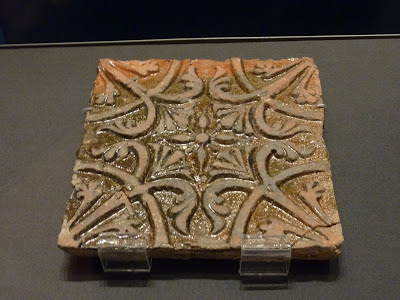
Today's research picture: This is a rather lovely floor tile from St. Alban's Abbey dating to the mid 12th century.
 |
| click to enlarge |


