Today it's back to William FitzStephens' description of London in the reign of Henry II and a little on fast food establishments! I wonder if McDonald's will ever served sturgeon and Guinea fowl!
Those that ply their several trades, the vendors of each several thing, the hirers out of their several sorts of labour are found every morning each in their separate quarters and each engaged upon his own peculiar task.
Moreover there is in London upon the river's bank, amid the wine that is sold from ships and wine cellars, the public cook shop. There, daily, according to the season, you may find viands, dishes roast, fried and boiled, fish great and small, the coarser flesh for the poor, the more delicate for the rich, such as venison and birds both big and little.
If friends, weary with travel should of a sudden come to any of the citizens, and it is not their pleasure to wait fasting till fresh food is bought and cooked and until servants bring water for hands and bread, they hasten to the river bank, and there all things desirable are ready to their hand. However great the infinitude of knights and foreigners that enter the city or are about to leave it, at whatever hour of night or day, that the former may not fast too long naught the latter depart without their dinner, they turned aside thither, if it so please them, and refresh themselves, each after his own manner.
Those who desire to fare delicately, need not search to find sturgeon or guinea fowl or Ionean francolin since all the dainties that are found there are set forth before their eyes.
Now this is a public cook-shop appropriate to the city and pertaining to the art of civic life. Hence that saying which we read in the Georgias of Plato, to wit, that's the art of cookery is a counterfeit of medicine and a flattery of the fourth part of the art of civic life.
Today's research photo: Mediaeval cooking pots circa 1200: Museum of London.
Saturday, February 09, 2013
Friday, February 08, 2013
Friday reads
Over at my Facebook page there's another Akashic research session posted.
Here on the blog are what I'm reading this week research wise and leisure wise.
Research. This is an excellent book and covers more than just the troubadours, giving the functions of squires and serjeants for example, and discussing chivalry and religeon in the area of the South of France. I'm learning a lot.
Leisure wise I am still reading last week's The Agincourt Bride as my downstairs fiction. For my bed-time reading I am re-reading (first read in 2003) A Game of Thrones and will continue on with the rest of the Ice and Fire series until I've got up. I haven't yet read A Feast for Crows and A Dance with Dragons. This one feels a lot more like historical fiction than a lot of historical fiction novels!
Here on the blog are what I'm reading this week research wise and leisure wise.
Research. This is an excellent book and covers more than just the troubadours, giving the functions of squires and serjeants for example, and discussing chivalry and religeon in the area of the South of France. I'm learning a lot.
Leisure wise I am still reading last week's The Agincourt Bride as my downstairs fiction. For my bed-time reading I am re-reading (first read in 2003) A Game of Thrones and will continue on with the rest of the Ice and Fire series until I've got up. I haven't yet read A Feast for Crows and A Dance with Dragons. This one feels a lot more like historical fiction than a lot of historical fiction novels!
Wednesday, February 06, 2013
Today's research snippet. A chronicler on the marital difficulties of Alienor of Aquitaine and Louis VII
I used the book listed to the left when resarching THE SUMMER QUEEN. John of Salisbury was one of the more reliable chroniclers of his day. A friend of Thomas Becket, he worked at the papal court and was an eye witness to the 'international' political struggles and scandals of the day. Here is John of Salisbury on the moment when Alienor and Henry came to visit the Pope on their way home from the 2nd crusade. Their marriage was in trouble...
Louis and Alienor were escorted to the Pope's residence at Tusculum.
" The lord pope received him (Louis) with such tenderness and reverence that one would have said he was welcoming an Angel of the lord rather than a mortal man. He reconciled the King and Queen, after hearing severally the accounts each gave of the estrangement begun at Antioch, and forbade any future mention of their consanguinity: confirming their marriage, both orally and in writing, he commanded under pain of anathema that no word should be spoken against it and that it should not be dissolved under any pretext what ever.
This ruling plainly delighted the King, for he loved the Queen passionately, in an almost childish way. The Pope made them sleep in the same bed, which he had decked with priceless hangings of his own; and daily during their brief visit (2 days) he strove by friendly conversation to restore love between them. He heaped gifts upon them; and when the moment came for departure, though he was a stern man, he could not hold back his tears, but sent them on their way blessing them and the kingdom of the Franks, which was higher in his esteem than all the kingdoms of the world.'
So what happened in Antioch you might ask? John of Salisbury has this to say:
in the year of grace 1149 the most Christian king of the Franks reached Antioch, after the destruction of his armies in the East, and was nobly entertained there by Prince Raymond, brother of the late William, Count of Poitiers. He was as it happens the Queen's uncle, and owed to the King loyalty, affection and respect for many reasons. But whilst they remained there to console, heal and revive the survivors from the wreck of the Army, the attention that was paid by the Prince to the Queen, and his constant, indeed almost continuous, conversation with her, aroused to the King's suspicions. These were greatly strengthened when the Queen wished to remain behind, although the King was preparing to leave, and the Prince made every effort to keep her, if the King would give his consent.
And when the King made haste to tear her way, she mentioned their kinship, saying it was not lawful for them to remain together as man and wife, since they were related in the fourth and fifth degrees. Even before their departure a rumour to that effect had been heard in France, where the late Bartholomew Bishop of Laon had calculated the degree of kinship; but it was not certain whether the reckoning was true or false.
At this the King was deeply moved; and although he loved the Queen almost beyond reason he consented to divorce her if his councillors and the French nobility would allow it. There was one knight amongst the King's secretaries, called Terricus Gualerancius (Thierry Galeran), a eunuch whom the Queen had always hated and mocked, but who was faithful and had the King's ear like his father's before him. He boldly persuaded the King not to suffer her to dally longer at Antioch, both because 'guilt under kinship's disguisse could lie concealed' and because it would be a lasting shame to the kingdom of the Franks if in addition to all the other disasters it was reported that the King had been deserted by his wife, or robbed of her. So he argued, either because he hated the Queen or because he really believed it, moved perchance by widespread rumour. In consequence she was torn away and forced to leave for Jerusalem with the King; and their mutual anger growing greater, the wound remained, hide it as best they might.'
You'll have to wait for THE SUMMER QUEEN to see what I make of it all! Although I have written a blog post about the Antioch incident. here http://livingthehistoryelizabethchadwick.blogspot.co.uk/2012/07/eleanor-of-aquitaine-raymond-of.html
Today's research photo is of The Becket Casket circa 1180. Gilded copper and Champleve enamel on a wooden core. At the time of its creation it may have housed relics of Becket's martyrdom.
Louis and Alienor were escorted to the Pope's residence at Tusculum.
" The lord pope received him (Louis) with such tenderness and reverence that one would have said he was welcoming an Angel of the lord rather than a mortal man. He reconciled the King and Queen, after hearing severally the accounts each gave of the estrangement begun at Antioch, and forbade any future mention of their consanguinity: confirming their marriage, both orally and in writing, he commanded under pain of anathema that no word should be spoken against it and that it should not be dissolved under any pretext what ever.
This ruling plainly delighted the King, for he loved the Queen passionately, in an almost childish way. The Pope made them sleep in the same bed, which he had decked with priceless hangings of his own; and daily during their brief visit (2 days) he strove by friendly conversation to restore love between them. He heaped gifts upon them; and when the moment came for departure, though he was a stern man, he could not hold back his tears, but sent them on their way blessing them and the kingdom of the Franks, which was higher in his esteem than all the kingdoms of the world.'
So what happened in Antioch you might ask? John of Salisbury has this to say:
in the year of grace 1149 the most Christian king of the Franks reached Antioch, after the destruction of his armies in the East, and was nobly entertained there by Prince Raymond, brother of the late William, Count of Poitiers. He was as it happens the Queen's uncle, and owed to the King loyalty, affection and respect for many reasons. But whilst they remained there to console, heal and revive the survivors from the wreck of the Army, the attention that was paid by the Prince to the Queen, and his constant, indeed almost continuous, conversation with her, aroused to the King's suspicions. These were greatly strengthened when the Queen wished to remain behind, although the King was preparing to leave, and the Prince made every effort to keep her, if the King would give his consent.
And when the King made haste to tear her way, she mentioned their kinship, saying it was not lawful for them to remain together as man and wife, since they were related in the fourth and fifth degrees. Even before their departure a rumour to that effect had been heard in France, where the late Bartholomew Bishop of Laon had calculated the degree of kinship; but it was not certain whether the reckoning was true or false.
At this the King was deeply moved; and although he loved the Queen almost beyond reason he consented to divorce her if his councillors and the French nobility would allow it. There was one knight amongst the King's secretaries, called Terricus Gualerancius (Thierry Galeran), a eunuch whom the Queen had always hated and mocked, but who was faithful and had the King's ear like his father's before him. He boldly persuaded the King not to suffer her to dally longer at Antioch, both because 'guilt under kinship's disguisse could lie concealed' and because it would be a lasting shame to the kingdom of the Franks if in addition to all the other disasters it was reported that the King had been deserted by his wife, or robbed of her. So he argued, either because he hated the Queen or because he really believed it, moved perchance by widespread rumour. In consequence she was torn away and forced to leave for Jerusalem with the King; and their mutual anger growing greater, the wound remained, hide it as best they might.'
You'll have to wait for THE SUMMER QUEEN to see what I make of it all! Although I have written a blog post about the Antioch incident. here http://livingthehistoryelizabethchadwick.blogspot.co.uk/2012/07/eleanor-of-aquitaine-raymond-of.html
Today's research photo is of The Becket Casket circa 1180. Gilded copper and Champleve enamel on a wooden core. At the time of its creation it may have housed relics of Becket's martyrdom.
Tuesday, February 05, 2013
Today's research snippet. The sweary bits
Bad Language.
So, we all know what constitutes swearing today, but what did a Medieval person say when they reached for an expletive? Societies tend to swear by things that are taboo or disgusting in their society, the usual subjects being religeon, scatology and sex.
Chronicler Daniel of Beccles writing in his work Urbanus Magnus in the late 12th century gave a list of swear words not to use including 'Do not swear by Christ's advent, birth, passion, body, brain, bowels, beard, tomb, ears, feet, arms, legs, back...by God's temple, voice, stomach, tongue... Most body parts were up for grabs. Henry II was renowned for swearing 'By God's eyes' and Richard I is known to have sworn by 'God's throat'. He also swore on his soul 'Par mon chief'. John is recorded as having sworn 'by God's teeth.' Gerald of Wales compares the kings of France favourably with the English ones (he was having a down on the Angevins at the time) by saying that they only swore by the saints of France and didn't go in for swearing by 'God's death, eyes, feet, teeth, throat or tumours.' William the Conqueror was accustomed to swearing 'By the resurrection and splendour of God.' William Rufus' favourite oath was 'By the Face of Lucca' (more on that another time) and Henry I's 'By God's death.' King Stephen apparently used 'By God's face.'
As well as religious insults there were the personal ones. One might insult someone by calling them a 'bricon' (fool) or a fils or fille de bas (bastard), or a puterelle (whore). You might refer to someone as stupid (coille) which has to do with testicles, or make mention of a loingoinge (cesspool or latrine). As in life today, there were grades of insults one could hurl at someone, and words that were ruder than others. This short, excellent article by Gillian Polack is excellent and lists a few of them with their gradations.
In current society we seem more concerned with the sexual insult (often sexually degrading particularly to women) and the scatalogical, perhaps because to the broad spread of society, religeon doesn't have the same importance it used to.
http://www.triviumpublishing.com/articles/fightingwords.html
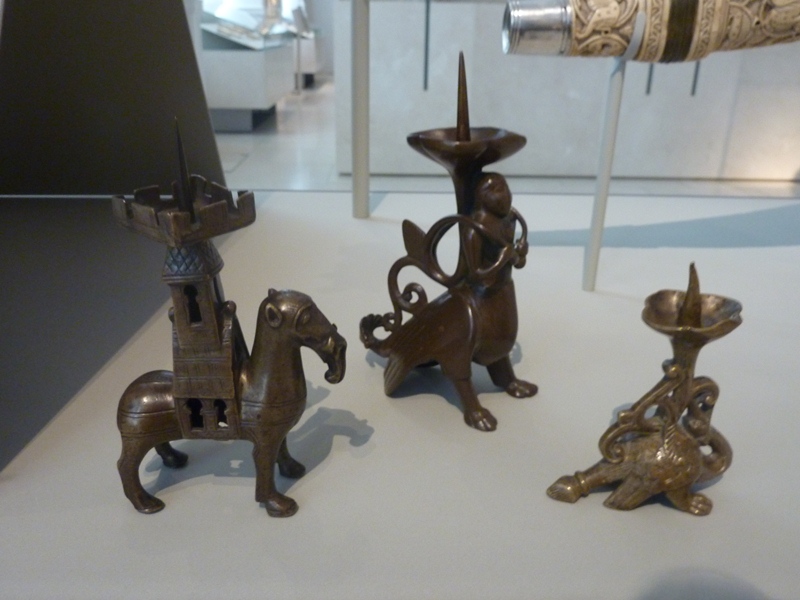
Today's research photo: 3 candlesticks from the late 12th, early 13th century. V&A
So, we all know what constitutes swearing today, but what did a Medieval person say when they reached for an expletive? Societies tend to swear by things that are taboo or disgusting in their society, the usual subjects being religeon, scatology and sex.
Chronicler Daniel of Beccles writing in his work Urbanus Magnus in the late 12th century gave a list of swear words not to use including 'Do not swear by Christ's advent, birth, passion, body, brain, bowels, beard, tomb, ears, feet, arms, legs, back...by God's temple, voice, stomach, tongue... Most body parts were up for grabs. Henry II was renowned for swearing 'By God's eyes' and Richard I is known to have sworn by 'God's throat'. He also swore on his soul 'Par mon chief'. John is recorded as having sworn 'by God's teeth.' Gerald of Wales compares the kings of France favourably with the English ones (he was having a down on the Angevins at the time) by saying that they only swore by the saints of France and didn't go in for swearing by 'God's death, eyes, feet, teeth, throat or tumours.' William the Conqueror was accustomed to swearing 'By the resurrection and splendour of God.' William Rufus' favourite oath was 'By the Face of Lucca' (more on that another time) and Henry I's 'By God's death.' King Stephen apparently used 'By God's face.'
As well as religious insults there were the personal ones. One might insult someone by calling them a 'bricon' (fool) or a fils or fille de bas (bastard), or a puterelle (whore). You might refer to someone as stupid (coille) which has to do with testicles, or make mention of a loingoinge (cesspool or latrine). As in life today, there were grades of insults one could hurl at someone, and words that were ruder than others. This short, excellent article by Gillian Polack is excellent and lists a few of them with their gradations.
In current society we seem more concerned with the sexual insult (often sexually degrading particularly to women) and the scatalogical, perhaps because to the broad spread of society, religeon doesn't have the same importance it used to.
http://www.triviumpublishing.com/articles/fightingwords.html
Today's research photo: 3 candlesticks from the late 12th, early 13th century. V&A
Sunday, February 03, 2013
Today's research snippet. A spear in the corner: The Assize of 1181
Henry II's Assize of Arms
In 1181, King Henry II made an 'Assize of Arms.' This was a legal obligation binding all free men of England to swear on oath that they would possess and bear arms in the service of their king and country. To make things clear, the document stipulated exactly what was required of each social strata in terms of the equipment a person should have. Essentially the Assize of Arms revived the old Anglo Saxon fyrd duty, the fyrd being a militia of ordinary people called out in times of need.
So, what were people expected to keep to hand in case of a call out?
1. Landowners of substance. Anyone owning enough land to support a knight's requirements, measured as a 'knight's fee' (earls might have over a thousand of these, whereas lesser nobility might scrape by on just the one or even less), was expected to provide a person with a shirt of mail, a shield and a lance, multiplied by the number of knights' fees he held.
2. Every free layman who is worth 16 marks in chattels and goods should have a mail shirt, a helmet, a shield, and a lance. Every free layman possessing chattels or rents to the value of 10 marks should shall have a hauberk, an iron cap, and a lance. This suggests that an iron cap was perhaps slightly less expensive than a helmet. Certainly when mentioned in the Histoire de Guillaume le Mareschal, iron caps are always used in the context of being 'lightly' armed. I don't have the Assize in Latin here so can't comment on the difference the translator has made in calling one a 'mail shirt' and the other a 'hauberk. Interestingly, 10 mark people and below are not required to carry a shield.
3. All the burgesses (town worthies basically) and the whole community of freeman shall each have a gambeson (padded tunic), an iron cap and a lance.
4. Everyone had to take an oath before the Feast of St. Hilary to be faithful to the King, here named as Henry II, son of the Empress Matilda. They are to bear arms in his service according to his command. No one is to sell their arms and armour, nor to pledge them to anyone, lend them, or alienate them in any way. A lord is not to alienate them from his men in any way.
5. Anyone who dies, must leave his armour and weapons to his heir who must take them up. But if the heir has not come of age, then the person responsible for them must find someone to bear arms in their stead. (I assume this must also happen if the heir is female).
6. Anyone having more arms than his entitlement, must dispose of them, either to others who do not have the required equipment, or in some other way. Stock piling is not allowed.
All very sensible for the life and times!
Today's research photo: Replica parade shield with gold leaf leopard. Original is circa 1200.
A bit too bling to keep in the rafters in case of emergencies!
In 1181, King Henry II made an 'Assize of Arms.' This was a legal obligation binding all free men of England to swear on oath that they would possess and bear arms in the service of their king and country. To make things clear, the document stipulated exactly what was required of each social strata in terms of the equipment a person should have. Essentially the Assize of Arms revived the old Anglo Saxon fyrd duty, the fyrd being a militia of ordinary people called out in times of need.
So, what were people expected to keep to hand in case of a call out?
1. Landowners of substance. Anyone owning enough land to support a knight's requirements, measured as a 'knight's fee' (earls might have over a thousand of these, whereas lesser nobility might scrape by on just the one or even less), was expected to provide a person with a shirt of mail, a shield and a lance, multiplied by the number of knights' fees he held.
2. Every free layman who is worth 16 marks in chattels and goods should have a mail shirt, a helmet, a shield, and a lance. Every free layman possessing chattels or rents to the value of 10 marks should shall have a hauberk, an iron cap, and a lance. This suggests that an iron cap was perhaps slightly less expensive than a helmet. Certainly when mentioned in the Histoire de Guillaume le Mareschal, iron caps are always used in the context of being 'lightly' armed. I don't have the Assize in Latin here so can't comment on the difference the translator has made in calling one a 'mail shirt' and the other a 'hauberk. Interestingly, 10 mark people and below are not required to carry a shield.
3. All the burgesses (town worthies basically) and the whole community of freeman shall each have a gambeson (padded tunic), an iron cap and a lance.
4. Everyone had to take an oath before the Feast of St. Hilary to be faithful to the King, here named as Henry II, son of the Empress Matilda. They are to bear arms in his service according to his command. No one is to sell their arms and armour, nor to pledge them to anyone, lend them, or alienate them in any way. A lord is not to alienate them from his men in any way.
5. Anyone who dies, must leave his armour and weapons to his heir who must take them up. But if the heir has not come of age, then the person responsible for them must find someone to bear arms in their stead. (I assume this must also happen if the heir is female).
6. Anyone having more arms than his entitlement, must dispose of them, either to others who do not have the required equipment, or in some other way. Stock piling is not allowed.
All very sensible for the life and times!
Today's research photo: Replica parade shield with gold leaf leopard. Original is circa 1200.
Saturday, February 02, 2013
Today's research snippet. Serjeants. Scum of the earth, salt of the earth
If you're a reader of my novels you will often come across me mentioning 'serjeants' in military roled. But what exactly is one?
Another name for a serjeant is a 'sirven' which is a broad term that covers both the notion of 'servant' and 'man-at-arms.' They were men who would perform menial tasks in the household such as making beds, preparing meals, making fires, but were also thoroughly capable of disarming a knight if ordered. All purpose common soldiers with duties both domestic and military more or less covers their role.
They were mostly excluded from the council chambers and when an army was on the road in battle mode, they were usually sent to do the dirty work. They were the pillagers and destroyers. The men who extorted ransoms and bullied hostages and generally made life miserables for the victims of their lord's displeasure or war mongering.
Despite this brutish assessment of their 'talents' they were seen as a valuable military resource rather than 'scum'. They were valued for their belligerance and fighting prowess. Those who had access to good equipment, which many did, were also valued.
Good equipment would consist of in the very best cases similar gear to a knight - a mail shirt, helmet, shield, spear, sword, axe, club etc
The mail shirt scenario was only for the top of the tree. The men in the middle would have had a head protector of some kind - the oft mentioned Chapel de fer - iron cap, but no one is quite sure what this is in the 12thC except that it's considered lighter wear than a full helm. They would have had a protective garment such as a gambeson, also called a pourpoint in 12th and 13thC texts and made of fabric or leather. Offensive weapons included axes, long-handed sickles, clubs, bows, crossbows, knives, rocks, slings, sharpened stakes - in fact anything to rack up the damage.
When on the road with an army the serjeants would perform such tasks as escorting siege engines and once settled in for the siege itself they would assist in siege work by filling the moats and sapping the walls. They kept watch, they worked on barricades, they supported archers and slingers, and might even have those skills themselves.
When it came to the thick of the fighting they acted as dispatchers to those whom the knights brought down but didn't kill. They mopped up.
Basically they were the dogs bodies, working in a support role, usually military, but kept busy when they weren't at war. The forebears of Tommy Atkins.
Today's research photo.
Detail of links from a mail shirt on display in the Museum of London.
Friday, February 01, 2013
Friday book feature.
On Fridays I don't post a research snippet to Facebook, instead I post an excerpt from my psychic research.
I thought on my blog on Fridays I'd post a research book I'm either reading or using at the moment, and also what I'm reading in my fiction leisure slot. The latter is very eclectic. I'm reading historical this week, but who knows what's next!
Research reading:
I've just read this one for general research and it's excellent. It even more convinces me, having read this that 'a surfeit of lampreys was a cover for the murder of Henry I (who supposedly died of eating this fish, but I suspect he was helped on his way). Highly recommended.
Leisure reading.
I'm reading and enjoying this one so far - began it Wednesday evening. Regular readers know that I will never, ever quote for books that I haven't bought, read and enjoyed myself. That way I keep my integrity and it's fair to other readers.
I thought on my blog on Fridays I'd post a research book I'm either reading or using at the moment, and also what I'm reading in my fiction leisure slot. The latter is very eclectic. I'm reading historical this week, but who knows what's next!
Research reading:
I've just read this one for general research and it's excellent. It even more convinces me, having read this that 'a surfeit of lampreys was a cover for the murder of Henry I (who supposedly died of eating this fish, but I suspect he was helped on his way). Highly recommended.
I'm reading and enjoying this one so far - began it Wednesday evening. Regular readers know that I will never, ever quote for books that I haven't bought, read and enjoyed myself. That way I keep my integrity and it's fair to other readers.
Subscribe to:
Posts (Atom)