Wednesday, February 02, 2011

Post Script to The Eleanor Vase

I mentioned that when I got round to writing up the next set of notes, I would add a post script to what Eleanor thought about giving her vase to Suger - according to the Akashic Record. Here is what came through when Alison tuned in.

Following on from our look at Louis giving Eleanor’s vase to Suger, I wanted to look at Eleanor’s reaction to this event. 1144

Alison: She feels quite tight across the heart area. This is an Eleanor who is quite worked up. Tight heart, tight cheeks, tight eyes. Emotional in an anxious way. I am getting the words ‘Please God, this has got to work.’ She is angry and not that bothered about the vase. This is about God. Her anger is connected to her relationship with God, so this is a direct communication with God. Suger is just a periphery. I think this is to do with wanting a boy child. It doesn’t seem fair. Why can’t she have what she wants? She will give anything, it doesn’t matter what, in order to have what she wants. So the actual item isn’t as relevant as what she wants. Suger to her is just someone who is doing what’s needed in the circumstances. Not quite a servant, but a functionary. It’s not up to him, it’s up to God. That’s how she sees it, although she wouldn’t say it outright. It wouldn’t be necessary. She can find Suger a bit annoying but he’s got a job to do. She’ll let him get on with his job, but this isn’t to do with him really. It’s to do with God. He’s just a functionary of God.

So this vase is to be given to God as a plea for her fertility? It’s more of a demand actually! She hardly even looks at the vase. It’s only in her side vision and the main part of her vision is to God. Why the vase and not a different gift? Well she could give anything. She doesn’t mind what it is, and it isn’t the only thing she’s given. She’s given loads of things. She’s given bags of gems. She’s given gold coverings to things. I am seeing one of those gold engraved domes that you put over tombs. She would rake around and give whatever it took.

Going off on a slight sidetrack: I wonder how Louis feels about Eleanor’s childlessness. He feels he must have done something wrong to displease God in such a way and he is starting to distrust Eleanor because just maybe she has done something wrong that he doesn’t know about, or there is something wrong in their relationship. His mind is working on those old fashioned things like consanguinity and something that’s displeasing to God about them being together. That’s one part of it. The other part is someone who is holding back sobs and just wants to cling on to Eleanor for comfort in their mutual sadness. She’s the one who comforts him. I can see his head on her chest and she is stroking his back and head.

This is interesting, as Ralph Turner speculates in his biography of Eleanor (page 68) that the vase was given not only to commemorate the dedication of St. Denis, but as a supplication in order that Eleanor and Louis might be fruitful.

Sunday, January 16, 2011

THE ELEANOR VASE

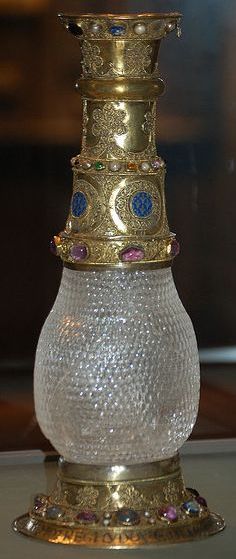
I have recently become interested in an object generally known today as 'The Eleanor of Aquitaine Vase.' It can now be seen on permanent display in the Louvre, the museum having acquired the piece in 1793 after the French Revolution. The object is known to have belonged to Eleanor of Aquitaine, who, having inherited it from her grandfather, William IX, gave it as a wedding gift to her first husband, Louis VII of France. In his turn, he gave it to Abbot Suger for his foundation of St. Denis, who used it as a communion vessel.

The vase has not always looked like this, and perhaps is not even a vase. The jewel-encrusted mountings at the top and base were a later addition and the original was a pear-shaped vessel with a neck two centimetres long. The rock crystal is carved in a 'honeycomb' pattern of about 22 rows of small hollowed out hexagons. Carved rock crystal containers have existed from antiquity, the Eastern Mediterranean appearing to be their source of origin at the outset. The craft flourished throughout the Middle East and was known in the Roman Empire. However, other than the Eleanor vase, the honeycomb pattern is only known to have been worked in glass, and as such, Eleanor's piece is utterly unique.
The Medieval world believed that rock crystal was fossilized ice and valued the material greatly. There are references from love poetry composed in Moorish Spain to rock crystal drinking cups, so perhaps the Eleanor Vase was originally one of these, or due to its great value, may have been a display piece. Indeed, it seems extremely likely that the object itself came from Muslim Spain as a gift to Eleanor's grandfather from the Emir Imad-al-dawla of Sarragossa, and would have come into William's possession in around 1120 when he was on battle campaign in Spain.
Experts are unsure of the dating of the vase, but suggest either the 6th or 7th centuries, or the 9th or 10th, but it was already an antique when it came into possession of the Dukes of Aquitaine. It was obviously highly valued by Eleanor for her to present it to her husband as a wedding gift.
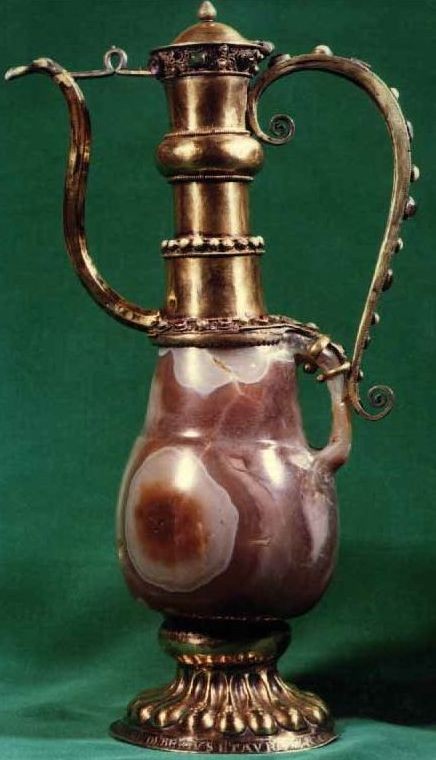
On June 11th 1144, Louis bestowed the vase on Abbot Suger at the dedication of the magnificent new church at St. Denis. Suger had a fine collection of precious stones and art objects, and the vase was a fine addition. Illustrated here are two more items from the collection. An eagle-headed vase with a porphry body,


and a Byzantine 7th century Ewer that found its way into his collection and bears the inscription DUM LIBARE DEO GEMMIS DEBEMUS ET AURO / HOC E (go) S (ugeri) US OFFERO VAS DOMINO” (Since we must sacrifice to God with gold and precious stones, I, Suger, offer this vase to the Lord).


Why did Louis give the rock crystal vase to him? Ralph Turner in his biography of Eleanor suggests that it was an offering to St. Denis in the hope that Louis and Eleanor's barren marriage might be blessed with a child (a daughter, Marie, was born the following year). It might have been that Louis valued Suger as an adviser and spiritual mentor and wanted to please him. Suger was to write that Louis had given him the vase 'as a tribute of his great love.' What Eleanor thought is not recorded, although I intend finding out!
Now in possession of the object, Suger set about putting his stamp on it. To beautify it perhaps and make it worthy of his treasury, or perhaps to make sure that it was never going to be given back! He had a base and a neck fashioned for the vase from gilded silver. On the base he put an inscription in niello, then a layer of filigree set with gemstones and decorated with more filigree work and fleurons. He had the neck of the vase similarly adorned. The inscription around the base reads: As a bride, Eleanor gave this vase to King Louis, Mitadolus to her grandfather, the King to me, and Suger to the saints.'

Suger died in January 1151, before Louis and Eleanor divorced. The vase, now a communion vessel remained in the treasury of St Denis down the centuries, but following the French Revolution came to its new home in the Louvre where, together with other items from the treasury of St. Denis, it can be viewed by visitors to the museum.


The Eleanor of Aquitaine Vase by George T. Beech in Eleanor of Aquitaine, Lord and Lady edited by Bonnie Wheeler and John. C. Parsons.

Eleanor of Aquitaine by Ralph V. Turner

The Louvre website http://www.louvre.fr/llv/commun/home.jsp

Friday, December 31, 2010

HAPPY NEW YEAR - I THINK!

First of all to wish everyone a very Happy New Year. May 2011 be happy, healthy and prosperous!

I thought I'd have a look at the Anglo Saxon Chronicle, which charts the history of England and sometimes its neighbours from the year 1 to the year 1154 and see what it had to say about the year eleven in each century - or the nearest if eleven isn't involved. Let's see.

11. Herod Antipas received the kingdom in Judea - good for him. Not sure if it was good for anyone else!

110 (nearest) Bishop Ignatius suffered martyrdom. Oh dear.

200 (nearest) The Holy Cross was found. - A good thing for some.

343. (nearest) St Nicholas passed away. No more Santa (have I got the right one?)

410 (nearest) The Goths broke into Rome, and never since has a Roman ruled in Britain. In all they ruled for four hundred and seventy years since Gaius Julius first sought out that island. - The end of civilisation then.

514 (2nd nearest) 'The West Saxons came into Britain with three ships to the place called Cerdicesora. Stuf and Wihtgar fought with the Britons and put them to flight.' Hmm, so his wife was always asking 'Where's my Stuf?'

611 Cynegils received the kingdom in Wessex, and held it for thirty one years. Settling down and being responsible now.

710 (nearest) Acca, Wilfrid's chaplain, received the bishopric which he had held. The same year, ealdorman Beorhtfrith fought with the Picts between the Avon and the Carron. Ine and Nun, his kinsman, fought with Geraint, the Welsh king. The same year Sygbald was killed. Beating up the neighbours as usual.

809 (nearest) The sun darkened at the beginning of the fifth hour of the day on Tuesday July 16th, the 29th day of the moon.

911, Aethelred, lord of the Mercians died; and King Edward received the boroughs of London and Oxford, with all the lands that belonged to them.

1011. Suddenly we've got a garrulous monk and Viking problems.
The king and his counsellors sent to the force and entreated peace, promised them tribute and provisions on the condition that they stop their ravaging. They had by then overrun i. East Anglia, ii Essex, iii Middlesex, iv Oxfordshire, v Cambridgeshire, vi Hertfordshire, vii Buckinghamshire, viii Bedfordshire, ix half Huntingdonshire, x much of Northamptonshire, all Kent, Sussex, Hastings, Surrey, Berkshire, Hampshire, and much of Wiltshire.
All this unhappiness befell us through bad counsel, that tribute was not promised them in time, nor were they withstood; but when they had done the most evil, men made truce and treaty with them. Nonetheless, for all this truce, treaty and tribute, they went everywhere in raiding bands, and plundered and killed our wretched folk. In this year between the Nativity of St. Mary and Michaelmas, they besieged Canterbury, and got in by deceit, because Aelmar, whose life Archbishop Aelfheah had saved, betrayed Canterbury to them. There they seized Archbishop Aelfheah, Aelfword the king's reeve, abbot Leofwine, bishop Godwine - and abbot Aelmaer they let go. Inside, they seized all the people in holy orders, men and women - it is impossible to say how many people that was - and stayed in that town as long as they wished. When they had explored the borough completely, they went to the ships and took the Archbishop with them. Then he was captive who had been England's head, and Christendom's, until the time they martyred him.

1111. King Henry did not bear his crown at Christmas, nor Easter, nor Pentecost, and in August he fared over the sea to Normandy because of hostility against him on some of the borders of France, and mostly because of the eorl of Anjou, who held Maine against him. After he came there, many fierce raids, burnings and ravagings they did between them.
This year passed away eorl Robert of Flanders, and his son Baldwin succeeded thereto.
This year, there was a very long winter, a heavy time and severe; through that the earth-crops were greatly spoiled, and there was the most death among livestock that anyone could remember.

The above series of extracts taken at approximately 100 year intervals kind of makes you glad to be living now and not then... But nothing really changes does it?

Once more
HAPPY NEW YEAR!
P.S. the illustrations is from a life of Thomas Becket, but it looks the part!

Friday, December 24, 2010

Lady of the English the book trailer

Well, having handed in Lady of the English, I decided to muck about making a book trailer before I start full work on the next project and I've posted it below. I like doing this for fun and I can claim it's work even if I'm playing!
My I wish compliments of the season to everyone wherever you are.
After Christmas I'll return to some more detailed historical posts.


-

Tuesday, December 14, 2010

Lady of the English - progress report

Well, I am delighted to say that I have FINALLY handed in LADY OF THE ENGLISH to my agent and editor. It's due for publication in UK hardcover in June 2011 and and by Sourcebooks USA in September 2011.

As many regular readers of the blog know, it's about the Empress Matilda and her young stepmother Adeliza of Louvain and their lives as they weave in and out of each other's spheres between the turbulent years 1125-1148. Both women held the title of 'Lady of the English' for parts of their lives, but neither of them ended their days in England. Their characters were very different, particularly in the way they dealt with trouble, yet there were similarites too. They shared a lot of common ground and knew each other well.
Matilda has something of a reputation for being a difficult, bad-tempered cow. The Gesta Stephani calls her headstrong in all that she did’ and says that she insulted and threatened men who came to submit to her. She did not rise to acknowledge men who bowed to her, and she refused to listen to their advice. ‘rebuffing them by an arrogant answer and refusing to hearken to their words…she no longer relied on their advice as she should have and had promised them, but arranged everything as she herself thought fit and according to her own arbitrary will.’ However, the monk Stephen of Rouen, praised her greatly, saying that she was much loved by the poor and the nobility alike. She was ‘wise and pious, merciful to the poor, generous to monks, the refuge of the wretched.' The Cistercian monks of le Valasse remembered her as ‘a woman of intelligence and sense.’ So while there may be no smoke without fire, perhaps history has served to exaggerate certain characteristics by concentrating on them rather than considering all facets, and perhaps has not looked closely enough at possible underlying reasons - something that an author of historical fiction can freely explore.

Lady of the English particularly looks at aspects of the important relationships that Adeliza and Matilda had with certain men in their lives.

King Henry I - Matilda's father and Adeliza's husband. His actions and behaviour had a massive and lasting impact on both women - much of it not to the good.

Geoffrey le Bel, count of Anjou - aged just 14 when he and Matilda, (more than 10 years older than him), were forced to marry in order to fulfil parental dynastic ambitions. What did she think of her adolescent husband? What did he think of his strong-willed much older wife? What actually happened behind closed doors?

Brian FitzCount - Matilda's right hand man and lord of Wallingford. But was he more to her than just a valued civil servant? He was interesting to research and not exactly as I expected to find. There's an article I wrote about him here in the blog archive. http://livingthehistoryelizabethchadwick.blogspot.com/2010/07/enigmatic-brian-fitzcount.html

William D'Albini - Lord of Buckenham in Norfolk and hereditary butler in the royal household. Adeliza's second husband. What was Adeliza's married life like with a much younger man who gave her her heart's desire, and yet opposed her support for Matilda? What kind of friction did it create?

Young Henry II, one day to become one of the greatest kings in Christendom. What was Matilda's relationship like with him as a child and a youth?

The above are the main relationships explored in the novel, but others are involved, including King Stephen, who as far as Matilda was concerned had usurped her throne, Robert of Gloucester, her loyal half-brother and commander of her forces, and Henry of Blois Bishop of Winchester, Papal Legate, Stephen's brother and a player of power games extraordinaire.

I love the cover, which I think really gives a feel for Matilda in one of her impatient moods.
It's as if she's been called from some important business and has swished aside a curtain to say 'Yes, what do you want then?' We tried the cover with two woman on it, but it didn't work half as well, and I am really pleased with this look. We also tried out different colours, but this was the one that evoked the best response. I hope to have it up at my website in the early New Year.

Prize draw closed and pending

A note to say that the draw for THE LEOPARD UNLEASHED is now closed. I have forwarded all the entries to my lovely Publicity lady at LittleBrown and she will choose 3 at random. I'll inform the winners as soon as LittleBrown get back to me.

Sunday, November 28, 2010

A few sundry bits of news and a UK prize draw

Hello all,

I am sorry not to have updated my blog in a while, but work has been getting in the way. I have a deadline of 30th December for LADY OF THE ENGLISH and I've been preparing the final draft. I want to get it handed in by mid-December so I can do the Christmas thing with my family so I've had my head down working. The good news is that I am on the final, final draft and it will be off to my publisher within a week to 10 days. I have also been shown a STUNNING cover rough for both this one and for the UK paperback of TO DEFY A KING which takes the hardback cover and give it a new crop suitable to commercial sales. I'll be posting pictures as soon as I get the go ahead from my publisher.
Once I hand in 'LADY', I hope to return to more regular posting.

I was very interested this week to see a piece about a tunnel that has just been discovered at Lincoln Castle. Alison King, my Akashic consultant 'saw' this about 6 months ago when we were conducting some research into the siege of Lincoln Castle in 1141. I said to her at the time that there weren't any tunnels at Lincoln Castle as far as I knew. And now this has turned up. Irrespective, it is a very interesting piece of archaeological discovery. I wonder what else will turn up as they continue. http://www.thisislincolnshire.co.uk/environment/Tunnel-vision-reveals-buildings-castle/article-2935933-detail/article.html

Okay, to celebrate the UK re-issue of The Leopard Unleashed, I am running a giveaway on the blog. Unfortunately this time it is limited to UK readers only, but I will certainly run the next draw internationally.
For those of you in the UK, my publisher Sphere is giving away a first prize of copies of THE WILD HUNT, THE RUNNING VIXEN and THE LEOPARD UNLEASHED and two runner up prizes of just THE LEOPARD UNLEASHED on its own. All you need to do is send an e-mail to me at elizabethchadwick@live.co.uk and I will forward all the names to Hannah at LittleBrown who will select the winners. I will ask the winners for a postal address, no need to send one at this stage - unless you want to. The draw is open as from now and I'll close it on Monday 13th December. You can find an excerpt from 'Leopard' here.
http://elizabethchadwicks.blogspot.com/2010/11/extract-from-leopard-unleashed.html