Monday, November 14, 2011

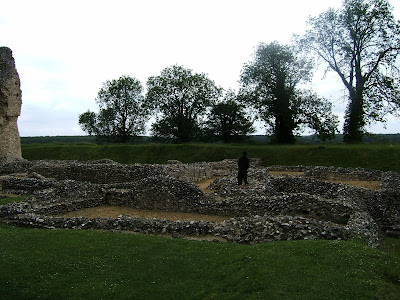
LUDGERSHALL CASTLE:

The ruins as they stand today and also see
the end of the post
The other day while nattering on Facebook, I got talking about Ludgershall Castle, and thought I’d blog about it. 

 It’s pretty much a crumbled ruin now and takes some strong imagination to flesh out, but at one time, while never being a top ranking castle, it was favoured by royalty and it had its part to play in the war between Stephen and Matilda.

The castle, situated on open  chalkland towards the eastern edge of Salisbury Plain, stands on the main route from Andover to Devizes and Marlborough. 
There has been a settlement at Ludgershall from Anglo Saxon times at least.  In 1015 it appears as a three hide holding under the name of Lutegaresheale in the will of the Aethling Aethelstan. By the time of the Domesday Book in 1086, it was in the hands of Edward of Salisbury, an Englishman who had (somehow) survived the Conquest and was the sheriff of the county.  He was William Marshal’s great grandfather and perhaps the first person to build a fortified residence at this prosperous manor which was worth six pounds and ten shillings at Domesday - an increase on its value from Edward the Confessor's day when it had only been worth £5.00
On Edward’s death, the manor and possible fortifications passed into the administration of  King Henry I who dated writs from there early in his reign.  By 1138 it was in the hands of the senior royal Marshal John FitzGilbert (hero of my novel A PLACE BEYOND COURAGE) and in 1141 it was the overnight refuge for Empress Matilda as she fled her enemies following the loss of Winchester. 
John was known as a castle builder par excellence. ‘he built castles designed with wondrous skill, in places that best suited him – from which he proceeded to terrorise the countryside.’ says the pro Stephen chronicle the Gesta Stephani.  John was probably originally given Ludgershall by King Stephen together with the castle at Marlborough, which enabled John to dominate the Kennet Valley.  His main rival in the area was Patrick  of Salisbury whose family had once owned Ludgershall.  Patrick set out to lay siege to Ludgershall and take it from John,  but John got wind of the plot and pre-empted Patrick, ambushing him along the way and sending him packing in a vicious pitched battle. With the blades of their spears and lances they joined battle so savagely that neither side spared the other in the slightest.  There were losses, there were gains, many a man killed and maimed, many a brain spilled from skull, and many a gut trailing on the ground...that day was a very bitter one: Patrick of Salisbury lost his best companions.

  In the end, Patrick and John came to an agreement whereby John divorced his wife, married Patrick’s sister, and got to keep Ludgershall.  Patrick was made an earl and the men became allies.
One gets a glimpse of the time of John Marshal from the finds report for the North Enclosure where the first tower was built.  Finds include scabbard chapes (the protective metal fitting on the base of a scabbard), arrow heads, spurs and javelin heads, knives and horseshoes.  There was also a stylus, decorated boxes, a pottery alembic, a book clasp, and a bone playing piece.   

Drawing of the top of a box - bone on wood from the time of John Marshal's occupation
Following the death of John Marshal, the castle was taken over once more by the crown and held by Henry II, and then in 1189 was given to his son John, at that time Count of Mortain.  When Richard returned from crusade, Ludgershall was removed from John and taken into Richard’s care until his death from an arrow wound at the siege of Chalus.  John on becoming King, spent money on Ludgershall. He had the park repaired and two new kitchens built.  Repairs were made to the King’s chamber and to the tower.  In 1217-1222 it passed back into the hands of the Marshal family before being handed back to the crown. Henry III had considerable building work done to the castle.  A writ of 30th June 1241 states: 
‘To the bailiff of Marlborough and Ludgershall, cause the queen’s chamber at Ludgershall over her bed, and the little wardrobe to be wainscoted; a porch to be made before the king’s chamber, to be 27 feet long and 18 feet deep.  The chapel of St. Nicholas to be whitened and roofed with shingles, a step to be made before the king’s great chamber, the windows to be barred with iron, and a small porch to be made before the door, and 3 windows to be made in the queen’s chamber.’

If John Marshal was quite the fearsome castle builder, Henry III was more of an interior decorator and domestic architect.  The above is only the tip of the iceberg!  Here’s another example

‘to make a gallery before the door of the queen’s chamber, and a covered passage from that door to the door of the hall; to paint the posts to imitate marble, and the story of Dives and Lazarus in the gable opposite the dais…

Ludgershall Castle in its 13th century heyday
These were Ludgershall’s glory days!

The castle passed to successive queens Anne of Bohemia and Joan of Navarre – the gatehouse and tower were repaired during her ownership up to 1437. In 1453 it was in the hands of Edmund Tudor Earl of Richmond.  1464 saw it owned by George Duke of Clarence, but its upkeep was being neglected.  It was no longer any use as even a minor defensive castle. By the visit of John Leland in the 1540's Ludgershall was reported on as being ruinous.
Today it is kept under watching brief by English Heritage, and it's free to visit. There's not much to see now, but English Heritage has produced a book detailing the findings of the  archaeological dig conducted there between 1961 and 1972, complete with a short history of the castle in the context of the finds.  It's published by the Wiltshire and Natural History Society Monograph Series 2 edited by Peter Ellis.isbn 0 947723072


Sunday, October 30, 2011

THE WITCH OF BERKELEY: A 12th century shiver tale for Halloween

mid 15thC witches
take to the air!
I thought in the spirit of the season, I'd post a witchy story told in The Deeds of the Kings of England (De Gestis Regum Anglorum) by William of Malmsbury circa 1125. (The monk responsible for the Historia Novela, dedicated to Robert of Gloucester and a chronicle pro the Angevin cause during the anarchy).   It's an anecdotal account, but William presents it as being just as true as the details of the kings whose lives he is chronichling. It's fascinating to look at primary source beliefs, folk rituals, and political slants on matters - enjoy!

THE WITCH OF BERKELEY.

... At this time and event occurred in England which was not a celestial miracle, but an infernal wonder. I am sure none of my listeners will doubt the story, although they might in fact wonder at it. I heard of these events from a distinguished man who swore he had seen them for himself, and I will be ashamed not to believe him…
… In Berkeley there was a woman who, so it was later said, was accustomed to wickedness and to the practice of ancient methods of augury and soothsaying. She was a creature of immodesty, who indulged her appetites. She had taken no heed scandal throughout her life but she was beginning to grow old and fearful of the battering footsteps of death. One day, as she was dining, a little crow which she kept as a pet uttered a cry that sounded like human speech. This startled her so much that she dropped her knife. Groaning sorrowfully, her face suddenly grown pale, she said: ‘Today my plough has turned its final furrow. I am about to hear and undergo great sorrow.’ At that moment, a messenger arrived, and hesitantly gave her the news of the death of her son, and the catastrophic annihilation of all her family's hopes.
            Wounded to the very heart, the woman took to her bed and, pained by a deadly sickness, summoned her remaining children, a monk and a nun. In a gasping voice, she said: ‘My children, I have enslaved myself to the artifice of the devil and have been the mistress of forbidden things. But despite my evil doings, I have always been accustomed to hope that my miserable soul might be eased in the end by the comforts of your religion. In my desperate straits, I always thought of you both as my champions against the demons, and my guardians against the most savage enemy. Now, as I end my life, I am likely to face the prospect of being tortured and punished by those very beings who used to be my advisers in sin. I implore you, therefore - I who brought you into the world and suckled you - to do all that you can from faith and pity to alleviate my coming torment. I do not expect that you can deflect the true judgement from my soul, but perhaps you can help me by attending to my body in the following way. Sew me up in the hide of a deer, and then place me face upwards in a stone sarcophagus, the lid sealed with lead and iron. Bind the stone with three heavy iron chains, and let there be 50 Psalms sung each night, and masses said each day to lessen the ferocious attacks of my enemies When I have lain secure in this way for three nights, bury me on the fourth day - although so grave are my sins, I fear the Earth itself might refuse to receive me to it's warming bosom.’
            All was done as she directed, her children attending the matter with great zeal and affection. But such had been her wickedness that no amount of piety and prayer availed against the violence of the devil. On the first and second night in vigil when choirs of clerics had gathered to sing melodious psalms around her bier, demons pulled apart the outer edges of the door of the church, which had been bolted with an iron bar, although the central part of the door which was of a more elaborate construction held fast). On the third night, around cock-crow, the enemy arrived making the most terrible noise, and all of the monastery was shaken to its foundations. One demonic creature larger and more terrible than the others, threw down the entrance door which was shattered into fragments. The priests stood rigid with dread, hair on end and voices stopped in their throats as the creature approached the sarcophagus with an arrogant swagger. The creature called the woman by name and ordered her to rise up, to which the reply came she was unable to do so because of the chains that bound the sarcophagus. ‘By the power of your sins you will be unbound,’ said the demon, and at once pulled apart the iron chain as though it were no more than a cord of flax. The coffin lid was thrown off, and the woman was seized and dragged out of the church before the horrified gaze of the observers. Outside the portals of the church a fierce black horse stood neighing with iron barbs protruding from along the length of its back. Onto these hooks the woman was placed, and the entire demonic retinue quickly disappeared from sight, although their cries of triumph and the woman's pleas for mercy could be heard up to 4 miles away.
            These events will not be thought incredible by anyone who has read the dialogues of the blessed Pope Gregory, who tells of the wicked man who was buried in a church and who was then passed out of it by demons. Among the French also the story is often told of Charles Martel, a man of such great prowess during his life that he forced the Saracens to retreat to Spain after their invasion of Gaul. Ending his days, he was buried in the church of St Denis, but because he had plundered the estates of almost all the monasteries of Gaul to pay his soldiers, his body was snatched from his tomb, and has never been seen since. This was later revealed by the Bishop of Orleans and the story has become widely known…

Thursday, October 13, 2011

EDWARD OF SALISBURY: A look at an unknown player who survived 1066

EDWARD OF SALISBURY

WHO? 

 That is what I would like to know too because he is a man almost completely overlooked by historians and novelists, and yet his unknown and untold story begs to be brought to light.

While researching my novels The Greatest Knight and The Scarlet Lion about the great William Marshal,  knight, courtier and regent extraordinaire of the Anglo Norman realm in the 12th and 13th centuries,  I came across William’s great grandfather – Edward and discovered that he was an Englishman, not a Norman, and that prior to the Conquest he had held extensive territories in Wiltshire – 35 manors at a rough count as well as other in neighbouring counties including Somerset and Hampshire.  He was high sheriff of Wiltshire during the reigns of William the Conqueror, William Rufus, and continued in office under Henry I until 1105, also serving as one of Henry’s chamberlains. He had the custody  of what is now the site of Old Sarum castle where there was once an extensive royal palace.
We know very little about Edward’s background and what we do have is obscure and muddled.   He was  possibly the son of a woman who appears as Wulfwyn in the Domesday Book for Wiltshire but no one can say for certain.  He was, however, of  English extraction, and had held land of King Edward. He not only survived the takeover at the top, he flourished.  It is thought that he married a Norman lady, but no one is sure of her name – possibly Matilda.
Whereas other English noblemen who survived the battle and the initial political upheaval, then went on to fall by the wayside ( Earl Waltheof of Huntingdon for example and the brothers Eadwin and Morcar of Mercia ), Edward of Salisbury enjoyed a full and rewarding career under his new Norman overlords, witnessing charters and being the man of the county.  His son Walter in his turn prospered, further bonding with the Norman aristocracy when he married one Sybilla de Chaworth.  Their daughter, also called Sybilla, married the royal marshal, John FitzGilbert and their second son William went on to rule England as Regent from 1216-1219.  Among Walter and Sybilla’s other children, Hawise was to marry first a French count and then a French prince. Walter’s son Patrick was granted an Earldom by the Empress Matilda.
What particularly fascinates me about Edward is how he managed to survive those early conquest years.  His lands lay in Godwin dominated territory.  He would have been foolish not to toe the party line and surely would not have survived long if he had shown signs of dissent because the Godwins could be ruthless to their enemies. We don’t know if he fought at Stamford Bridge or at Hastings.  However, if he did, (on the English side)  it doesn’t seem to have put him at a disadvantage with his new overlords – a state of affairs that is almost unique as an English aristocratic experience at this time.  If he fought for the Normans, then how did he manage to stay alive until it was safe to declare his interest?  What kind of man would have the ability to wind his way through the changing and treacherous politics of this period, hold onto his lands and prosper when all around him his countrymen were falling?  He’s an unknown and his story is not helped by Victorian historians who have mixed up his family tree with a totally different Norman one.  
 One of these days I would love to go and do some proper digging and find out just how he managed to survive and prosper.  It certainly seems to me that he passed his amazing ability to ride the waves, down the genes to his rather better known great grandson!

Photo of Josh Beaumont of the Conroi de Vey  by Rosemary Watson 

Sunday, September 18, 2011

HANDSOME IS AS HANDSOME DOES :Geoffrey le Bel: A short biography.

Geoffrey le Bel  Count of Anjou  August 1113 –  September 7th 1151
Geoffrey Le Bel,  Count of Anjou and briefly Duke of Normandy, has featured in several of my novels as a secondary character. Recently he had a strong supporting role in Lady of the English, and he will have his part to play in The Summer Queen, my work in progress about Eleanor of Aquitaine. Indeed, in a couple of highly suspect chronicles, his involvement in Eleanor's history is the source of shocking scandal, and has led certain 'popular biographers' to arrive at rather murky and sordid conclusions concerning his interaction with Eleanor, but we'll come to that in a while.


Geoffrey was born circa 1113, the first of the four children of Fulke V Count of Anjou and Erembourg of Maine. He had two dynamic sisters, Sybilla and Alais, and a brother Elias.  Sybilla, after an eventful early life and two marriages, died in the holy land, where although a nun, she advised and helped her father's widowed wife Melisende to rule the kingdom of Jerusalem.  Alais, having been widowed at a young age, eventually became an abbess at the Abbey of Fontevrault. Elias spent his time either rebelling against Geoffrey or being imprisoned by him and eventually died as a result of a spell of the latter.
Geoffrey was known as Geoffrey le Bel – meaning the good-looking. He is described as having ‘A fair and ruddy countenance lit up by the lightning glance of a pair of brilliant eyes, and a tall slender sinewy frame made for grace no less than  for strength.’  He was also accounted to have ‘a gracious manner and a ready, pleasant speech.’ History has also left us the detail that he was red-haired. His tomb plaque shows us a dashing bronze-haired man dressed in the height of fashion and holding the blue shield with gold lioncels that was given to him at his knighting by his future father-in-law King Henry I of England.
Geoffrey was afforded the best education his father could arrange.  He was quick-witted and intelligent and a fast learner.  He was very interested in history, and could recount the battles fought and the deeds done by his ancestors and others. Not only did young Geoffrey absorb the necessary intellectual education, the skills of chivalry, etiquette and manners were honed until they shone in his public persona. Nor was his military education neglected and he learned all the warrior arts, both the practical and the theory.  
            Geoffrey is credited with being the founder of the Plantagenet line.  The name comes from the yellow broom flower - the planta genista - that grows in abundance in Maine (France) and with which Geoffrey is supposed to have adorned his cap.
            His life changed dramatically at the age of just 13 when Fulke V was offered the throne of the Kingdom of Jerusalem.  Around this time, Fulke and King Henry I of England began negotiating a marriage between Geoffrey, and Henry I’s 25 year old daughter Matilda. She had recently returned from Germany, a widow and her father had had his barons swear to honour her as the heir to England.  Here was the chance of a lifetime for young Geoffrey.  Even if he didn’t get to wear England’s crown and remained  a consort to an eventually ruling queen,  this was an ambitious hike up the ladder.  There would be England and Normandy to govern in partnership with his wife, and the opportunity to sire future royalty.  
What Geoffrey thought personally of marrying a woman 12 years older than himself and what the Empress thought of marrying a youth whose voice must scarcely have broken, is not recorded.   
          They married on the the  17th of June 1128 when Geoffrey was 2 months short of his 15th birthday and Matilda was 26.  Soon afterwards they separated for 18 months.  The reasons are not known.  Some historians put it down to incompatibility, others say that Geoffrey was facing rebellions in his lands as his barons fought to dislodge their inexperienced young count and that it was prudent for Matilda to be out of the way.  Whatever the reason, Matilda left Geoffrey in summer 1129 and did not return to him until September 1131.  They were to be together for another 9 months before Matilda became pregnant.  She bore their first son, the future Henry II in the March of 1133 when Geoffrey was just 19 years old.
            The Empress was to bear Geoffrey two more sons. The birth of her second, Geoffrey, in Rouen in 1134 almost killed her.  Having eventually recovered, she returned to Anjou and bore their third and last child William in 1136.  Geoffrey also had at least two illegitimate children who were raised in  his household - Hamelin, who was to become Earl of Surrey and Warenne and a staunch lifelong companion of Henry II, and Emma, who was to marry David, Prince of Gwynedd.
            When King Henry I died, his lands were claimed by his nephew Stephen who was supported by the English and Norman barons, and Matilda was left out in the cold.  She and Geoffrey swiftly set about attempting to reclaim her inheritance for themselves and their sons.  Matilda’s arena was to be England while Geoffrey set about tackling Normandy.  He was no longer the untried adolescent.  Certainly he was still a young man, but a shrewd and battle-hardened one, and not a risk taker.  He made mistakes, but he learned from them, and he was not afraid to cut his losses and try again if matters did not go his way the first time.  He was dogged. His early attempts to make inroads into Normandy in 1136/7 were foiled when his army succumbed to dysentery and he was seriously injured in the foot.  Geoffrey beat a retreat to Anjou, but like a tide, was only gone for a short while and returned each campaigning season and surge upon surge gradually brought Normandy under his rule.  He was aided in this by the gradual defection of many of the Norman barons from Stephen.  At one point Geoffrey did lay off activity, but only because Stephen agreed to pay him two thousand marks for three years to stay away.  It was very likely money out of King Henry I’s quickly draining treasury and Geoffrey and Matilda would have viewed the sum not only as part of her inheritance from her father, but also as funds for their battle campaigin.  Stephen wasn’t paying his enemies to stay away, rather he was funding their war chest for a later date.
            Geoffrey eventually won Normandy and became its official duke in the summer of 1144.  A couple of years after this, he began to consider an ambitious marriage alliance for his eldest son Henry.  In 1145, the Queen of France, Eleanor Duchess of Aquitaine had borne a daughter, Marie.  While the little girl could not inherit the French throne, she was heir to the vast and attractive lands of Aquitaine.  Geoffrey proposed a marriage between Henry and little Marie, and Louis agreed to consider it.  On the surface this might seem a little odd, since Louis’ sister Constance was married to King Stephen’s eldest son Eustace, but there is nothing like putting your eggs in more than one basket and Geoffrey, as Duke of Normandy was becoming increasingly powerful and a force to be reckoned with.  As it happened, the proposal was nixed by the church who said that the degree of consanguinity was too great, but perhaps it was also a get out clause.  Geoffrey, however, remained on cordial terms with the French crown, and even helped Abbot Suger to keep the peace while Louis was absent on crusade.
            During his brief visits to the French court, Geoffrey would have mingled with the charismatic Queen Eleanor.  There are rumours in the writings of the gossipy and  highly unreliable pair Walter Map and Gerald of Wales, that Geoffrey had an affair with Eleanor.  Walter Map, says that there were ‘rumours’ that Eleanor and Geoffrey of Anjou were lovers.  The nearest he got to those rumours if they existed outside of his own head, was being a student in Paris in 1150-1160.  Gerald of Wales who was a mere toddler at the time that Map would have heard the rumours (if there were any), reports almost 70 years later in 1216,  that the affair actually happened. So Gerald has made into fact a piece of gossip from an unreliable source.  Gerald himself is renowned for his agendas against the Angevins and for his poisoned pen.  If he didn’t like you, then he made up scurrilous tales about you.  I am reminded of the innuendo of today’s hack journalists.  Also, having seen in the publishing industry how facts can become warped by a simple, innocent error, I’m inclined to be sceptical of Walter and Gerald.  (The other day I was cited on the internet as having written the script of the movie First Knight.  I didn’t.  I adapted the script, which is a different matter entirely – kind of the difference between flirting and having and affair!)
            Leaving that aside, it’s hard to know when Geoffrey and Eleanor would have had the time and opportunity to get it on.  Geoffrey is not known to have spent much time at the French court, being too occupied in his campaigns in Normandy, and Alienor did not get much time to herself to go rutting in Aquitaine!   Not only that, but they were both far too politically astute to be ruled by lust.  There were way too many political brakes on the cart for it ever to run away. Certainly there may have been some flirting, strong eye contact and physical attraction, but I seriously doubt that it led to any sort of exchange of body fluids between the Queen of France and her husband’s vassal!
            I have a notion – not quite a theory – that Eleanor may have flirted with Geoffrey at the French court in 1151 in order to put her husband Louis off the scent that she was considering a match with Geoffrey’s son Henry.  Geoffrey had given the Duchy of Normandy to Henry in 1149 and the father and son’s visit to court in 1151 was part of an exercise in smoothing the waters.  Around this time, Eleanor and Louis were in the throes of divorcing. Louis would have done everything in his power to prevent a marriage between Eleanor and Henry of Anjou had he known about it.  So perhaps a flirtation with Geoffrey was by way of a  decoy.
            Following their visit to the French court, Geoffrey and Henry set off home.  The end of summer weather was burning hot and 39 year old Geoffrey plunged into a river to cool himself off. The result was a fever from which he was to die on the 7th of September in the small border fortress of Chateau du Loire.  His deathbed advice to his son was not to change the customs of the lands over which he would rule.  Let each keep their own.
 On his death, he was buried as requested not at Tours or Angers with his ancestors, but in his mother’s town of Le Mans where Henry himself had been born.  All that remains today of the sumptuous original tomb that had stood in the cathedral of St. Julien is the enamelled plaque, which paints a vivid picture of Geoffrey, insomuch as medieval portraiture can ever do. It accurately shows his blue shield with its gold lioncels, the red-gold hair, and the brilliant eyes.
            Historian Kate Norgate says of Geoffrey that he ‘lacked steady principle and genuine feeling.’  I disagree with her.  I think Geoffrey had strong principles, and that he loved his son Henry very deeply indeed.  Everything was geared towards putting Henry on the ladder and shouldering him upwards.  Geoffrey (and Matilda) saw that their son was educated as a fitting king and Duke. If Henry II was one of the greatest kings England has ever known, then part of it is down to his father who played a great part in his son’s upbringing. However, Norgate does concede that he had ‘dogged Angevin thoroughness.’  Professor David Crouch calls it ‘remorseless patience.’ In his biography of King Stephen, Crouch is also of the opinion ‘In retrospect, one is rather driven to the conclusion that the Anglo Norman aristocracy had made a serious error when they rejected Count Geoffrey as their king-consort in 1135.’

Additional note and anecdotes.
Shortly after Geoffrey’s death, a history of his life was put together. Historia Gaufredi ducis Normannorum et comitis Andegavorum written by John of Marmoutier.  It’s mostly a paen to its subject, but there are still moments that give us glimpses of Geoffrey’s character, and here are a couple.
           
There is the story of a discontented knight who's ill will against Geoffrey took the form of a wish that he had the neck of ‘that redhead Geoffrey’ fast between the two hot iron plates used to make a wafer cake called an oublie. It chanced that the oublie maker who had heard the knight say this, was making wafers for Geoffrey at St Aignan and told Geoffrey all about it.  Not long after this, the knight who had made the remark was caught by Geoffrey harrying his lands. Geoffrey generously forgave the man, not only his depredations but also the fact that he had expressed a desire to make a wafer out of him!

Another time Geoffrey with a great train of attendants and guests was keeping Christmas at Le Mans.  Leaving his private chapel where he had been attending the nocturnal services of the vigil he set out at the head of a procession to celebrate Christmas in the cathedral church.  Near the door he met a poorly dressed young clerk whom he flippantly saluted with ‘Any news sir clerkling?’
‘Aye my Lord. The best of good news!’
‘What?’ cried  Geoffrey all of his curiosity aroused. ‘Tell me quick!’
‘Unto us a child is born unto us a Son is given!’
Abashed Geoffrey asked the clerk his name and bade him join the other clergy and the choir and as soon as matters were over went straight to the Bishop and said ‘For the love of Him who was born this day, give me a prebend in your church.’  It was no sooner granted and taking his new acquaintance by the hand he begged leave to make him his substitute and added the further gift of a stall in his own chapel as a token of gratitude to the poor clerk, whose answer to Geoffrey’s thoughtless question had brought home to him the true meaning of Christmas morning.

You can find a third anecdote from this chronicle in Lady of the English, which involves Geoffrey becoming lost in the woods and having a discourse with a charcoal burner!


Further reading:
The Plantagenet Chronicles: General Editor Elizabeth Hallam: Weidenfeld & Nicholson 1986

England Under the Angevin Kings Vol I  - Kate Norgate – reprint by Elibron Classics

Eleanor of Aquitaine Queen and Rebel by John Flori – Edinburgh University Press (sets out in an unbiased and non sensational way, the arguments about whether or not Geoffrey had an affair with Eleanor)

Contest - quick update

A note to say the prize draw contest is still running, so there's still a chance to enter (see the previous post)   I will close it on September 30th, 12 noon UK time.

Thursday, August 18, 2011

A blog on publication day.

Today sees the official publication of TO DEFY A KING in paperback.  Previously published in hardcover and also available on Kindle and audio it is now to be had in glorious paberback.  The cover has been revamped from the hardcover to make it brighter and give it more standout appeal on the supermarket and chain store bookshelf.  It has also been stickered as the very proud winner of the RNA award for historical fiction 2011.  I'm having a small celebratory prize draw.  See the foot of the blog for details.

So what exactly is the RNA award?

 The RNA is the UK's Romantic Novelists Association. http://www.rna-uk.org/ It's a broad church open to published authors across the wide spectrum of romantic fiction genres.  It embraces mainstream fiction, literary fiction, historical fiction, romantic comedy, contemporary and historical sagas, and even some crime fiction.  It also champions category romance including the rich and varied seam belonging to Mills & Boon.  The RNA also has an associate membership for industry professionals such as authors, editors and agents.  The association has an annual scheme to assist new writers coming through - the New Writers Scheme.  This is immensely popular and always over-subscribed.  It is responsible for the discovery of new talent, brings new blood regularly into the RNA and has kick started many a stellar career.  As well as conferences, famed London parties and seminars, the RNA also has an award for the best romantic novel of the year with sub categories for the best historical novel, the best romantic comedy and the best love story, the latter geared towards category romances where the romance is fully up front. Although the award rulings are subject to change, the above is the gist.
What is terrific about these awards is that the longlist is chosen by ordinary readers.  The publishers enter the books for the award (usually several hundred contenders) and they are parcelled up and sent out to volunteers who are not members of the RNA but who are passionate about reading.  They score the books according to various criteria based on plot, characterisation, content etc.  Each book receives 2 reads and the scores are added up. Top scores go onto the longlist which is then read by RNA members not connected with the award and without novels of their own involved.  The books are whittled down to a shortlist of 6 and these are then judged by a panel of industry professionals and a winner announced. Previous judges have included Tim Waterstone, Jenny Murray, Richard Lee, founder of the Historical Novel Society, Janine Cook, head buyer for Waterstones, and novelist Amanda Craig. Previous winners include Rosamund Pilcher, Philippa Gregory, Susan Kay, Freya North, Cathy Kelly and JoJo Moyes. Shortlistees have included Dorothy Dunnett, Joanne Harris and Nicholas Sparks.

This year's awards were announced at champagne reception and canapes event at Number One Whitehall, London - and a brilliant day out it was too.  TO DEFY A KING was on two shortlists, and although it didn't win the all categories, was named the winner of the Historical Novel prize - see the sidebar of the blog.

I credit the RNA with keeping me in a job earlier in my career during some very difficult times.  Historical fiction was in the doldrums and I was one of the endangered midlist authors.  I saw many of my historical novelist colleagues lose their place in publishing. However, the readers kept putting my books through to the shortlist of the RNA awards and this showed my publisher that there was an appetite out there for what I was producing and also, through publicity, it raised reader awareness that bit higher and helped build my platform.  TO DEFY A KING is my fifth shortlisting.  Since it's out today, I'd like to raise a toast to my publishers, to the novel, to the readers, and to the RNA.  Salute!

These are my other, reader-chosen shortlisted novels from previous years.


To celebrate today's publication, I am offering a giveaway of a copy of To Defy a King plus a novel of your choice to one UK reader and one overseas reader.  Just drop an e-mail to elizabethchadwick@live.co.uk, stating clearly whether you are a UK or overseas entry.

NB. If you've tried and it hasn't worked, I'm sorry.  I wrote my address wrong the first time - I put a dot in where there wasn't one (sigh). Anyway, it's fixed now.  However, Live can be sensitive, so if you can't get through, leave a message on the blog, or contact me through Twitter or Facebook.


Monday, August 15, 2011

FINDING PETRONELLA - More Conundrums

NB This is NOT Petronella (fitting given the contents below) but just a suggestive image to brighten the blog!
Nothing is ever simple when it comes to researching Eleanor of Aquitaine, her family and her affiliations. Having wrestled with the problem of her half brothers and having proven that Joscelin was actually the brother of Queen Adeliza of Louvain, I now find myself with several puzzles concerning Eleanor’s younger sister Petronella. Except sometimes she's not call Petronella, she is called Aelith.  Already I'm beginning to suspect that I am going to wind up banging my head on the table in frustration.

There is no birth date for Petronella. We now know that Eleanor was born in 1124 not 1122. Petronella was a younger sibling.  We know their mother died in 1130 and that Petronella was old enough to be involved in a sexual relationship by 1141, and that she bore a child circa 1143 or 1144.  It is therefore likely that she was born fairly close to Eleanor, perhaps in 1125 or 1126. Having said that we have no birth date for the brother William Aigret, who died around the same time as their mother in 1130. Some biographers say he was first born, some that Eleanor was first born. No one seems to know, and William’s birth order may have affected the dating of Petronella's birth.  In the great scheme of things, it’s really just a minor puzzle though.

With regard to Petronella's alternative name, I do wonder if she was baptised Aelith but known as Petronella, perhaps because her birth date was close to the feast of St. Petronella on the 31st of May, and perhaps because St. Petronella had associations with Charlemagne from whom she and Eleanor claimed descent.  It may also be telling that the cathedral in Poitiers is dedicated to St Peter, who seems to have loomed large in the lives of the Dukes of Aquitaine,  Petronella being  the feminine form of Peter. 
Or of course, she could have been baptised  Petronella.and called Ailith.  Or Eleanor may have had two sisters – perhaps Aelith was illegitimate. The mention of Ailith comes from existing documentation concerned with the Abbey of St Mary of Saintes.  Perhaps Aelith was a nun?  I don’t know.  I feel probably not, but it is still there as a consideration when pondering all the possibilities. 

Here is a letter from 1140 naming the sister known as Aelith.  It’s also interesting to see ‘Eleanor’ rendered in Medieval Latin.  I have bolded Aelith’s name in the text.

1140, December 28
Original letter:
Ego Helienordis, Francorum regina, et Willelmi ducis Aquitanici filia, hoc donum, sicut rex vir meus concessit Beate Marie Xancton[ensi] ecclesie, sic concessi et hujus [sign of cross] impressione confirmavi, et in perpetuo habendum Sancte Marie et Agneti amite mee ejusdem loci abbatisse, et omnibus ejus successoribus in eadem die, non in eodem loco, confirmavi; videntibus Aienrico de Niela, Aelith, sorore mea, Maengo de Bono Occulo, Arveo panetario, et pluribus aliis.
Translated letter:
I Eleanor, queen of the Franks, and daughter of William duke of Aquitaine, have granted and confirmed by this stamp* the gift as the king my husband granted it to the church of Blessed Mary of Saintes, to be held in perpetuity by St. Mary and Agnes, my aunt, abbess of that place, and all her successors, I confirmed it on the same day not in the same place: with witnesses Aienric (Henry?) of Niela, Aelith my sister, Maengo of Bono Occulo, Arveo my steward, and many others.
We do know that in 1142, Petronella, then in her early or mid teens, began an affair with King Louis’ much older, war-scarred second cousin, Ralph of Vermandois.  He had lost an eye in a siege, when struck by an arrow, but as well as being a warrior, he was a valued and experienced courtier.  He also liked the ladies.  Chronicler John of Salisbury tells us that even when ordered to abstain from intercourse by his doctors, he paid them no heed because he was ‘very uxorius’.  He was married to Leonora – some say niece of Count Theobald of Blois (Ralph Turner, Douglas Boyd, Marion Meade, Desmond Seward, Marjorie Chibnall, Amy Kelly)  some say sister of (Alison Weir, Wikipedia) and some say first cousin (Ivan Goubry). You see what I’m up against when researching?!  Anyway, the couple were keen to wed and three bishops – including Ralph’s brother, Simon Bishop of Noyon, annulled Ralph’s first marriage. The Pope, on receiving a complaint from Theobald of Champagne on his disparaged sister’s/niece’s/cousin’s/take your pick behalf, immediately reversed the annulment and put Ralph and Petronella under interdict.  Without going into masses of political detail at this stage, it caused tremendous political upheaval and was partly the cause of a war between France and Champagne.
Ralph and Petronella weathered the storm and Petronella bore Ralph either two or (here we go again) 3 children. Some time in the early 1150’s she died…. Or did she?  Off I go to bang my head on the table.
UK Wikipedia says: However, Petronilla and Raoul divorced in 1151, as he remarried the next year. Petronilla remained a member of the French royal court and a constant companion to her sister Eleanor while she was imprisoned by her husband King Henry II in England and Wales. After Henry's death, Eleanor was freed, and Petronilla planned on returning to France. Yet, records of Petronilla after 1189 are scarce. It is believed that she came down with a fever on her voyage from England back to France and died in early 1190 before her arrival at port.  
There are no sources given for this bit of information, although the entire article is quoted as sourced from a French work by Patrick van Kerrebrouck (2000). Les Capétiens 987–1328. Since I have no access to this work, I can’t check the veracity or whether Petronella’s death is mentioned in it.  Records of Petronella before 1189 are hardly leaping out of the woodwork, and I suspect that here ‘scarce’ is a euphemism for ‘non existent.’
 French Wikipedia says she died after 1151 and that Ralph was widowed. ‘devenu veuf’  In 1152 he married his 3rd wife Lauretta of Alsace.
Chronicler John of Salisbury writing circa 1164 saysShe did not survive for long; and though she bore a son and two daughters  before her death.’…’ ‘As for Count Ralph, he married his 3rd wife, a daughter of Thierry count of Flanders called Laura.’This being from primary source it’s more promising.
Then I came across this url.http://fmg.ac/Projects/MedLands/AQUITAINE.htm#AelisPetronilledied1153
ELIS [Petronille] d'Aquitaine ([1125]-after 24 Oct 1151, bur St Arnould in Crépy).  The Chronicle of Alberic de Trois-Fontaines specifies that "Alienor Guilielmi filia comits Pictavorum et Aquitanie ducis" had two sisters one of whom married "Radulfus…comes Perone et Veromandie", although he does not name them[562].  The Historiæ Tornacenses record the wife of "Radulfem comitem" as "germanam Alienore regine Francorum" but also do not name her[563].  Robert of Torigny refers to the mother of the infant children of "Radulfus de Perrona comes Viromandorum" as "iuniore filia Willelmi ducis Aquitanorum" but he does not name her either[564].  The Chronique de Guillaume de Nangis names "Eléonore et Pétronille" as the two daughters of "Guillaume comte de Poitou et prince d'Aquitaine", recording in 1142 that Pétronille married "Raoul comte de Vermandois" after he repudiated his first wife[565]m (1142) as his second wife, RAOUL I "le Vaillant" Comte de Vermandois, son of HUGUES "le Maisné" de France Comte de Vermandois & his wife Adelais Ctss de Vermandois, de Valois et de Crépy ([1094]-13 Oct 1152, bur Priory of Saint-Arnoul de Crépy). 
The above source has Petronella buried at the Priory of Saint Arnould de Crepy. Note the mention of two sisters in the above source details.  Which brings us back to Aelith and Petronella as separate individuals rather than the same person.
Now, to further muddy the waters, the English Pipe Rolls of 1155 to 1158 carry at least a strong suggestion that Petronella was still alive after Ralph’s remarriage to Laura of Flanders and hadn’t died as John of Salisbury says. There is a reference to a Petronille in close proximity to mention of the Queen with reference to payment of Danegeld in the Pipe Roll for Essex of l155, and chances are highly likely that it is her sister.   In that of 1158, there is a reference to a payment for the passage of the Queen’s sister (it doesn’t name her and the wording just might possibly refer to the King’s sister – in which case it would be an illegitimate one).
Look at the last word on the 3rd long line down and just above it the word 'Regine
Alison Weir states: ‘During the period 1154-58, there are regular payments of generous sums for wine for Petronilla.’
 Having trawled these same pipe rolls, I can find only one such entry and it involves bread as well as wine and does not name Petronella herself and is therefore ambiguous.   There is only one mention of a Petronella ( see above full paragraph and photo).  The other un-named mentions of a sister might or might not be Petronella.  The entries could as easily refer to Henry II’s illegitimate sister Emma, later to marry Dafydd ap Owain Gwynedd, prince of North Wales.  It’s not clear enough to say for certain, as ‘Reg’ or 'R' could be short for ‘Regis’ as well as ‘Regine.’


Current conclusion. Until more evidence turns up, my personal belief, based on the seriously muddled and  contradictory evidence is that Eleanor definitely had a sister called Petronella and that she married Ralph of Vermandois.  They divorced, and Petronella came to live with her sister Eleanor, and died some time after 1155 but before 1164.  I am not entirely satisfied with this conclusion, but it’s the most I can go on at the moment.  What I need to find out is where the UK Wikipedia got its statement from that Petronella was still alive in 1189.  It may well be from a novel, but without references, I can go no further, and as everyone knows, while Wikipedia is a good starting point, it’s never to be trusted.  My inner jury is also out on the Aelith business. Two sisters, or one with dual names?  It’s in the balance…and there are dints in my table!