Saturday, September 15, 2012

THE GIVEAWAYS CONTINUE!

The giveaway for A PLACE BEYOND COURAGE is now closed.  Congratulations to the winners.  UK and overseas -  Jenny Quinlan, Kate Sands and Kim Moss.  USA  Aimee Bajorek, Lisa Margolis and Kelly Place.

 But it's not over!   I am holding a NEW draw to celebrate the paperback UK release of LADY OF THE ENGLISH on Thursday 13th September.  It's a busy month for me with releases of these different books in the UK and the USA.

I have 3 copies of LADY OF THE ENGLISH in paperback to give away in the UK and the rest of the world excluding USA.  However, if you are in the USA, I do have one of my Sourcebooks editions of LADY OF THE ENGLISH (different cover)  to give away -  so that I don't leave anyone out!

If you want to enter the drawing for  LADY OF THE ENGLISH, just send an e-mail to elizabethchadwick@live.co.uk and I will add you to the list.  Please say if it's for the USA draw.

Closing date will be 2nd October.  I'm away at the HNS conference on the 30th September,  so I'll leave it open a couple more days.

Short excerpt:
"At length, it was Matilda who broke the taut silence. ‘When I return from this ride, I am going to tell my father that I will accept this marriage with Anjou.’
            He looked straight ahead and said stiffly, ‘That is a wise decision, Domina.’  
             She shook her head. ‘I make it because I have no choice.  I make it because if I refuse, the House of Anjou will become our enemy and unite with France and Flanders. I know why my father considers it a wise and prudent move.  She nudged her mare closer to Sable and fixed him with a steady look. ‘But tell me, my lord, did you think of all the consequences when you discussed the matter with him in private council?
            Shadows like delicate bruises were smudged beneath her eyes and Brian  had to glance away. ‘Yes, Domina, I did…but your father would not be gainsaid, and in truth, his reasons are sound.’
            ‘And you cannot look at me, my lord.’
            ‘What would you have me do?’ Now he did meet her stare and forced himself not to flinch from her scrutiny. ‘I am your father’s liege man first, even while I honour his daughter.’
            ‘Honour.’ She exhaled down her nose. ‘I wonder at the substance with which we gild that word.’
            ‘When the time comes, I will not fail you; I swear on my own life.’
            ‘And who will call that time, my lord - You, or I?  And who will decide if you have or have not failed?’
            They rode in silence again, and Brian kept his distance because he knew that if he let her in, he would fall apart under the truth of her stare and he could allow that to happen.  She was right.  Honour was both a gilded fancy and a stinking corpse, and she had not been the one to murder it in the name of strategy."

Monday, September 10, 2012

EMPRESS MATILDA'S BLING REPRISED

As LADY OF THE ENGLISH approaches publication day in the UK, I thought I'd reprise an earlier post on the Empress Matilda's treasures and wealth. The illustrations are all either firmly within my own copyright, or have permissions for use and I have lightly edited the text.  The photos are representative of the kind of objects with which the Empress would have surrounded herself.


Empress Matilda's Bling!

During the course of my research into Empress Matilda, I found a very interesting list of some of the riches she owned in her lifetime, so I thought I'd write a shiny post today, detailing that list and illustrating it with items similar to the originals, or dating from that time in history. (click on the images to enlarge). Matilda does seem to have liked her rich fabrics, gold and jewels, but when one examines any royal wardrobe list the same trend becomes obvious. Material wealth of the 'bling' variety in the Middle Ages wasn't just about being shiny and flashing wealth upon the person to enhance status (although that was part of it).  It was also about favour and patronage. Religeous establishments benefitted from rich gifts and became the storage places for much of that wealth - sort of unofficial banks where the goods could be kept safe until needed.  The royal personage got to store their valuables in safety and the establishment benefited from the patronage and status such a service conveyed.  Since many of the items  had religious connotations,  it was also about glory to God.
 Gold and silver artefacts and rich textiles were the rainy day funds should the monarchy fall on hard times. Mercenaries could be paid in jewels and gold cups. Loans could be secured against the wealth. In the early thirteenth century, William Marshal used just this ploy when he became regent. Whatever was left in the royal treasury at Corfe was used to pay the soldiers and keep them in the field. There was no coin to be had, but there were sapphires and emeralds, gold cups and bolts of silk.

Henry I had stored up a vast amount of wealth in his treasury, but when Stephen took the throne he used it to buy soldiers, to buy support, and to buy off the opposition.  We know that he gave items from the royal treasury to his older brother Theobald of Champagne as a settlement against Theobald relinquishing his claim to England and Normandy.  Theobald then used some of that wealth as a contribution  to the building of the new abbey church of St. Denis.
But back to the Empress. When Matilda left Germany as a widow in 1125 or 1126, she returned to Normandy bearing a wealth of treasure acquired during her marriage - among which was at least one dubious (mis) appropriation - the Hand of Saint James, which she presented to Reading Abbey. There is a little about the hand here.
http://www.strangebritain.co.uk/allthingsodd/hand.html The hand, however, would originally have been displayed in a ornate relic case perhaps looking a little like this one.  The see-through windows on the fingers would originally have contained fragments of a saint's bones.    Click to enlarge

Later on, the German emperor asked for the return of the hand, but Matilda wasn't having it and offered him a large travelling tent instead. (fashioned from rich materials and so big it had to be raised mechanically). I suppose that exchange is no robbery...

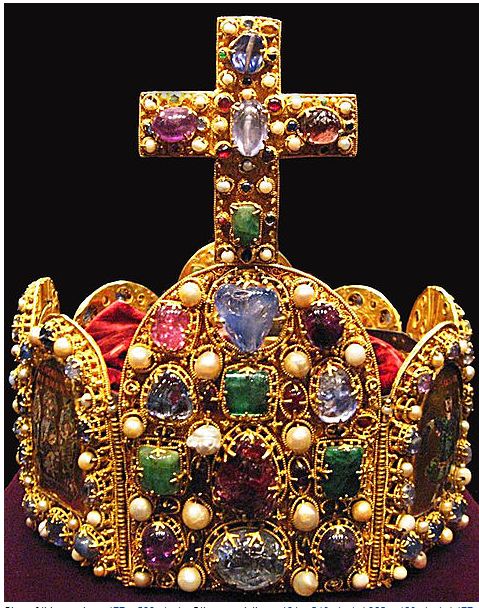
Matilda also returned from Germany with at least two crowns that had been worn by her husband the Emperor. One 'of solid gold, decorated with gems' was worn by Henry II at his coronation and was so heavy that it had to be supported by two silver rods when worn. The front of the crown was adorned by a jewel of great size and value with a gold cross superimposed. The smaller of the crowns had been used by the emperor on feast days. Matilda also had a crown of her own, decorated with golden flowers.

Imperial crown of the Holy Roman Empire. It is made in hinged segments, so can be packed flat for travel.


Among the gifts Matilda gave to the Abbey at Bec0Hellouin were the above mentioned crowns and also ar golden cross decorated with precious stones, two gospel books bound in gold and studded with gems, two silver-gilt censers, a silver incense box and spoon, a gold dish and a gold pyx for the Eucharist. There were three silver flasks, a ewer for holy water and a silver basin. Add to this two portable altars of marble mounted in silver and an ebony chest filled with relics. There were more textiles in the forms of holy vestments - chasubles, dalmatics, copes, and an imperial cloak belonging to herself, besprinkled with gold. All of the above list was donated in her lifetime. 
After she died, the abbey also received the ornaments she had used in her own private chapel. These included service books, a gold chalice and spoon, four chasubles, two tunics, two dalmatics, six copes, two of which were interwoven with silver, two silver censers and two boxes which were described as 'eggs of griffins'. The legs and claws gripping these 'eggs' were fashioned of silver. The griffin's eggs could have been many things. Ostrich eggs, which were highly prized, or egg-shaped polished agates as per the Greek legends. We don't know. There was a popular 12th century story about Alexander the Great harnessing a pair of Griffins and having them fly him to heaven to see God, only to be asked by an angel why he wanted to see God when he didn't yet understand the world he lived in. Chastened, Alexander flew back to earth. Perhaps Matilda had this pair of griffon's eggs on her altar as a reminder of this legend, who knows?
Gospel book with parts dating from 10th to 12th century

All the above was just the tip of the iceberg. Empress Matilda truly did live in a world of sumptuous glittered. When she died, as well as all her treasure, she gave thirty thousand shillings to the Grandmontine order. In physical terms at least, the Empress died a wealthy woman.
Below, I've added quick links to show what chasubles, copes and dalmatics are.

Chasuble http://en.wikipedia.org/wiki/ChasubleDalmatic http://en.wikipedia.org/wiki/DalmaticCope http://en.wikipedia.org/wiki/Cope


The Alton Towers tryptych.  Germany circa 1150

w


Saturday, September 01, 2012

A MONTH OF GIVEAWAYS!

First my apologies.
Life has been drastically busy chez Chadwick.
Outside of the day job, my father has just had major surgery.  He's out of hospital and doing well, but obviously helping him out has taken time from my schedule even while things have been hotting up on the writerly front, so if I'm a bit off the pace, there are reasons behind the scenes.

Anyway, I have suddenly realised that September 1st is publication day in the USA for A PLACE BEYOND COURAGE, and September 13th is when the UK paperback of LADY OF THE ENGLISH hits the bookshelves, so I thought I'd better get moving on a few celebratory giveaways.

A PLACE BEYOND COURAGE has been awarded a wonderful starred review by Publishers Weekly in the USA

A Place Beyond Courage
Elizabeth Chadwick. Sourcebooks Landmark, $14.99 trade paper (512p) ISBN 978-1-4022-7108-3
In this spellbinding prequel to 2009’s The Greatest Knight, Chadwick takes readers on a tour of royal intrigue in 12th-century England. After a fortune-teller reveals to a young royal servant named John FitzGilbert Marshal that one of his offspring will one day rule England, the unmarried man laughs in her face. Later, John’s wives—first the pious and meek Aline, and then the sassy spitfire Sybilla—bear him multiple children, and it soon becomes clear that at least one of them is destined for greatness. As an honorable servant to King Henry, John’s loyalties are thrown into turmoil upon his beloved leader’s death. He goes on to pledge allegiance to the new King Stephen, but others are less sure of the new monarch. As warring parties struggle for the throne, John must reconcile his wishes for his children with what is best for his country, and what he himself most desires. Based on real characters and extensive research, Chadwick’s imaginative tale will keep readers captive till the final page. 
Reviewed on: 07/27/2012

I have three copies to give away to USA readers - signed by me.  Just drop an e-mail to elizabethchadwick@live.co.uk and I'll enter you in the draw.  Please state you're from the USA so as to avoid confusion.
A PLACE BEYOND COURAGE has also been reissued by my UK publishers with a new cover, so if you're in the UK I also have 3 copies here to give away - 2 to UK readers and another one for overseas excluding the USA.  Again, just send me a note to the above e-mail and I'll enter you.

Closing date Saturday 15th September - on which date I will be opening a brand new giveaway for copies of Lady of the English UK paperback. Watch this space!

IN OTHER NEWS

I have a gorgeous new website now at www.elizabethchadwick.com  with new colours and features.  Do drop by and have a look.

I have handed in my Eleanor of Aquitaine novel THE SUMMER QUEEN and can now happily report that my agent said 'Wow!' and used words like 'Wonderful, powerful, major piece of writing.  My editor agreed and said 'unputdownable.'  I'm not an ego-freak, but it's lovely to have this validation of the writing and the research.  It's been a long haul!


Monday, July 16, 2012

Eleanor of Aquitaine, Raymond of Poitiers and the Incident at Antioch.

One of the notorious players in Eleanor of Aquitaine's life story  is her paternal  uncle Raymond of Poitiers, Prince of Antioch.  His notoriety is caused not least by the rumours of an affair between him and his niece when she visited him in his city during the second crusade.

We don't have a solid birth date for Raymond. Wikipedia says circa 1115, but since he was at the court of Henry I of England in 1130, I would err on the side of that circa being before 1115.  His parents were William IX, Duke of Aquitaine, and his second wife Philippa, daughter of Count William IV of Toulouse.  His older brother William was destined to become Duke of Aquitaine and father of the above mentioned Eleanor,  but there was no inheritance for young Raymond and he left Aquitaine to seek his fortune at the court of Henry I, King of England where he was welcomed among the able young courtiers surrounding the king. There is charter evidence for him being there by 1130 when he was pardoned the sum of 7 shillings.
While Raymond was occupied at the English court, doings were afoot in the Holy Land.  The Christian held Principality of Antioch was in need of a ruler. Bohemond II,  lord of Antioch had been killed at the Battle of Mamistra in 1131.  His head had been cut off, enbalmed, and sent in a silver casket  to the Caliph of Baghdad.  He left behind his widow, Alice, sister of Queen Melisande of Jerusalem, and his small daughter, Constance.   Through his maternal bloodline, Bohemond was related to the French royal house and was cousin to Louis VII, husband of Eleanor of Aquitaine.
King Fulke of Jerusalem and Queen Melisande began casting around for a husband for Constance and their gaze lit upon young Raymond of Poitiers. Fulke's son was married to Henry I's daughter, and it is feasible that the recommendation came to Fulke and Melisande via influences at the English court.
 A Hospitaler knight called Gerard Jebarre was sent to England to fetch Raymond to his new calling.  The journey to Antioch was difficult because the politics of the Mediterranean and the Middle East of the time meant that there were those who did not want to see Raymond take up the reins.  Raymond had to undertake his voyage in secrecy, disguising himself as a pilgrim and as a merchant's servant, but he was fortunate and managed to slip through the blockade, arriving in Antioch in April 1136.
His arrival could not be hidden from the Princess Alice, Constance's mother who was still a young and fertile woman, and expected to become  Raymond's bride.  However, the politics of the moment were geared towards uniting her daugher with Raymond because young Constance had the blood of Count Bohemond in her veins and Alice did not.
While Alice waited expectantly in her palace to receive her future new husband,nine year old Constance was kidnapped and married to Raymond in haste by the patriarch of Antioch  Thwarted, unable to fight for her position and rights, Alice retired to her dower estates in Lattakieh.
Raymond took up governing his new principality. He is described by contemporaries as handsome, tall and elegant. He possessed immense physical strength - he was supposed to be able to bend an iron bar with his bare hands and was nicknamed 'Hercules'. He was skilled in the use of arms and militarily experienced.  Although not literate himself, he fostered those who were and enjoyed culture.  He liked gambling and was known to be impetuous and hot-tempered,  but he also had a high reputation for gallantry and purity of conduct (words in  bold for a reason). He attended church regularly and was a faithful husband to Constance who in the fullness of time bore him a son Bohemond, and daughters Maria and Philippa. 
Raymond had a difficult row to hoe politically and I only touch on it in passing in The Summer Queen. Suffice to say that as his rule progressed, the divisions between the Christian princes widened and the Muslim opposition took advantage where they could, with the result that the neighbouring principality of Edessa fell  in 1144 and help was sought in Europe, culminating in the debacle of the second crusade.  Raymond himself wrote to Louis of France seeking aid for Antioch and Edessa.  He might have expected plenty of help because the Queen of France, Eleanor, was his own niece and Duchess of Aquitaine, and Constance was blood kin to Louis.
It could be said that Raymond, as the brother of the last duke of Aquitaine, was the male figurehead of the dynastic household, even while Eleanor was the reigning  duchess. His word would have carried clout in an advisory capacity with her and with the men of Aquitaine she had brought with her.  When Raymond originally sent to France requesting aid, he accompanied his plea with all manner of costly gifts (some might say bribes)  from Antioch.
Louis was keen to go on a dual pilgrimage/crusade and Eleanor accompanied him. The reasons behind her presence on the crusade have been fair game for writers of historical fiction and biographers alike.  Some have her being bored to tears and champing at the bit to be gone from France and heading off on an adventure.  Others have seen it as a case of Louis bringing her along because there was no telling what she might do in France during his absence, and he needed her as the queen bee in a hive to keep the Aquitaine troops loyal and engaged.
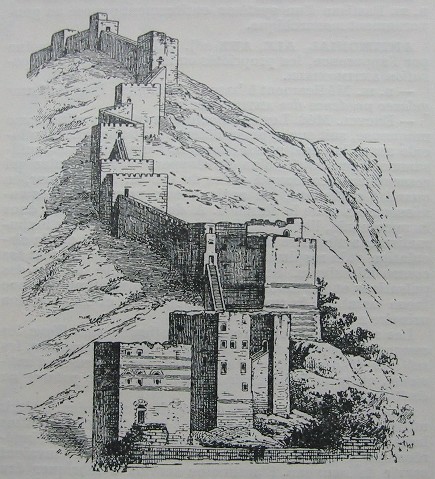
Ramparts of Antioch
Whatever the reasons and motivation, Eleanor and Louis set out for the Holy Land in the spring of 1146 and after a series of difficulties along the way, arrived in Antioch in the middle of March 1148.  Raymond was delighted to see them and rode out to greet them at the port of St. Symeon and welcome them to his city.
Raymond seemed to hope that Eleanor would be able to influence Louis and persuade him to campaign with him in assaulting the city of Aleppo which was the greatest threat to Antioch's security. He 'counted greatly on the interest of the queen with the lord king.'  And of course his own wife was kin to Louis, so perhaps he hoped for a certain amount of persuasion from that direction too. He quickly discovered that it was not to be the case.  Eleanor might heartily agree with him but her relationship with Louis was on the skids and she was of a mind to part company with him, something she announced at Antioch.  Far from being a bridge between the two men, Eleanor was a divider.
She spent so much time in her uncle's council during the time they were there, that various chroniclers and clerics would find it a source of scandal and hint at improprieties committed that went far beyond the pale. Eleanor's biographers have debated long over the matter of whether Raymond of Poitiers and his niece became incestuous lovers during her sojourn in Aquitaine.
The main players are dead; we can't ask them and perhaps they wouldn't tell, but there are certain pointers that lead me to personally believe that Eleanor and her uncle did not have an incestuous fling during her stay in Antioch. That's not to say that there wasn't an 'incident' while she was there.  Something patently did happen to knot the underwear of the chroniclers, but I would hazard one of three things.

1. What they thought they saw and what really happened are two different matters.
2. They are referencing a different scandal to the one everyone has assumed involves Eleanor and her uncle - and you will just have to read the novel to obtain my version!
3. The references are to some kind of serious plot against Louis involving Eleanor and her uncle.

 Chronicler John of Salisbury is our most reliable source.  He's a sober type of chap not given to making stuff up just because it's colourful and he feels like it. (Unlike Gerald of Wales, who is less picky about truth and lies).  Having said that, historian Andrew Buck has pointed out to me that both John of Salisbury and William of Tyre were as prone to fabrication and political manipulation of their work as many other chroniclers and that William of Tyre looked to Jerusalem and was not exactly pro-Antiochene in his stance.

John of Salisbury says:
In the year of grace 1149 (March 1148) the most Christian King of the Franks reached Antioch, after the destruction of his armies in the east, and was nobly entertained there by Prince Raymond, brother of the late William count of Poitiers.  He was as it happened the queen's uncle, and owed the king loyalty, affection and respect for many reasons. (John of Salisbury does not say what these reasons are). But whilst they remained there to console, heal and revive the survivors from the wreck of the army, the attentions paid by the prince to the queen, and his constant, indeed almost continuous conversation with her, aroused the king's suspicions.  These were greatly strengthened when the queen wished to remain behind, although the king was preparing to leave, and the prince made every effort to keep her, if the king would give his consent. And when the king made haste to tear her away, she mentioned their kinship, saying it was not lawful for them to remain together as man and wife, since they were related in the fourth and fifth degrees.  Even before their departure a rumour to that effect had been heard in France.... At this the king was deeply moved; and although he loved the queen almost beyond reason he consented to divorce her if his counsellors and the French nobility would allow it.  There was one knight amongst the king's secretaries called Terricus Gauleranicus, a eunuch whom the queen had always hated and mocked, but who was faithful and had the king's ear like his father's before him.  He boldly persuaded the king not to suffer her to dally longer in Antioch both because 'guilt under kinship's disguise could lie concealed.'  (a quote from Ovid). and because it would be a lasting shame to the kingdom of the Franks if in addition to all the other disasters it was reported that the king had been deserted by his wife, or robbed of her.  So he argued, either because he hated the queen or because he really believed it, moved perchance by widespread rumour.  In consequence she was torn away and forced to leave for Jerusalem with the king; and their mutual anger growing greater, the wound remained, hide it as best they might.'

Was the above hinting that Eleanor and Raymond had totally lost their wits and their political sanity and been so overwhelmed by lust that in the circa ten days they were together they committed incest?  Nothing in the above piece suggests this, even though some modern biographers appear to think it damning and authors of historical fiction have had a field day.   Is it possible? Absolutely.  Is it likely on a scale of 1-10?  Ummm, how about a 1?
 That Eleanor wanted out of her marriage is obvious and that Raymond was willing to help her in this is obvious too.  Louis had chosen not to throw in his lot with Raymond and attack Aleppo, and the state of the relationship between Louis and Eleanor meant that she was not a good bridge as a peacemaker and path smoother between the two men.  With Louis determined to go on to Jerusalem,  it could well be that Raymond wanted to retain the men of Aquitaine for his own projects and how better to do it that than to keep Eleanor with him?  I have no doubt that Eleanor and Raymond sided with each other.  It stands to sense they would and John of Salisbury's description bears this out.  But to have an incestuous relationship?  If one looks at the timing, the characters, and the political situation, it all adds up to a negative.
Both were highly intelligent and astute; one a ruler of a great Middle Eastern principality and the other the Queen of France and Duchess of Aquitaine.  They had huge political roles as well as personal lives. In those personal lives, Raymond was commended for purity and faithfulness. Eleanor's reputation was not so lily-white but down to hostility from the court and the church based among other things on her inability to provide Louis with a male heir and some disastrous headstrong decisions taken in her teen years. She may well have liked to flirt, but that doesn't make her a sex mad idiot. Condemnation of her character is not universal either, and there are texts such as the Histoire de Guillaume le Mareschal that sing her praises.
 Eleanor spent less than two weeks in Antioch and part of that time was recuperating from a difficult sea journey and earlier trials in Anatolia.  It hardly seems likely that she and Raymond would get down and dirty in that short space of time in what would be tantamount to a one night stand.  However, she may well have been plotting to overthrow her husband or dump him. Chronicler William of Tyre says that Eleanor was a 'rash woman. Lost to all sense of queenly dignity, she disregarded the marriage bond and forgot her duty to be faithful to her husband.'  But he was only eighteen when the Antioch incident happened and not on site,  and being faithful to one's husband in the medieval sense also had the connotation of keeping faith and didn't automatically mean the sexual act. To think that it did shows the same problematic modern mindset that believes Richard I and Philippe Augustus sharing a bed makes them sexual partners.
William of Tyre never names the man in his accusation, which is is interesting.  Historians have always taken it to be Raymond, but if one does go down the road of believing Eleanor sought comfort elsewhere, then perhaps they should widen the field and look to other, less closely related men - but of course that's another story.
Eleanor would not be the first queen accused by enemies of plotting with a lover.  Melisande of Jerusalem, whom Eleanor was to meet, was accused by her rivals of conducting an affair with one of her nobles, Hugh of le Puiset, lord of Jaffa. Melisande managed to win through and turn the tables on her detractors, but sullying the name of a ruling woman one wanted to bring down, was a firmly recognised tactic.
As mentioned above, Eleanor was torn away from Antioch at night by Louis - the inference being that she did not want to go with him and greatly resented him for his action.  Louis in his turn was furious with Eleanor but was advised by Abbot Suger in a letter to 'conceal your rancour against the queen.'  Basically Louis was being told to hold onto Eleanor until they got back to France because of the wealth, power and prestige of Aquitaine.
 Raymond did not pursue his escapees.  He had too much ado keeping Antioch together and fighting off his aggressive neighbours. Nor was he entirely sure of the motivations of his Christian supposed allies.
Raymond and Eleanor never saw each other again.  Raymond was killed fighting at the Battle of Inab in 1149.  He was beheaded by Shirkuh, uncle of Saladin, and like his father in law before him, his embalmed head was sent in a silver box as a gift to the Caliph of Baghdad. (one wonders what the Caliph did with his head collection!).
Eleanor would have received the news of his death while on her way home to France.  Her response is not recorded, but the death of her sole remaining male relative on her father's side must have come as a blow, and would hardly have improved the strained relations between herself and Louis. If Louis had done as Raymond wanted and lent his troops to take on Aleppo, then Raymond might have survived.
Raymond's widow went on to marry the notorious Reynald of Chatillon, a French knight among Louis' entourage who chose to remain in the Holy Land and carve out a future for himself.  He too ended his life headless when he was decapitated by Saladin following the disastrous battle at Hattin.

The bottom line is that we will never know using the traditional historical resources available to us if Eleanor and her uncle Raymond indulged in an affair during her time in Antioch.  Those who think she did say that the evidence lies in:

1. The word of three reliable chroniclers (John of Salisbury, William of Tyre, Richard of Devizes),  and several others less reliable, but nevertheless no smoke without fire. (Gerald of Wales, Walter Map).
2. Circumstantial evidence such as the sudden termination of the chronicle of Louis' chaplain  Odo de Deuil at Antioch, and Louis' letters to Suger concerning his anger at the queen.

Those who argue against it (and I'm one of them) say:
1. The reliable chroniclers speak of matters that could well be interpreted as plotting behind Louis' back (which makes sense and is likely)  but nowhere do they actually say that Eleanor committed incest with her uncle.
2. The less reliable chroniclers are known for their poisoned pen approach to rumours and could make Mount Everest out of a grain of sand even without the added goad of wanting to defame a ruling family out of personal pique for slights assumed - and they don't say Raymond and Eleanor did the deed either; they just hint darkly.
3. The less reliable chronicles were writing decades after the events.
4. Timing - and this is what sells it for me.  Seriously, does it make sense for two politically experienced people, uncle and niece, the former with a reputation for marital fidelity, to go into lustful overdrive in the space of less than a fortnight?  Come off it.

My opinion is that something DID happen at Antioch but there is enough circumstantial evidence to convince me that big though it was,  it wasn't incest.

Make up your own mind.  What do you think?

Select bibliography.

Article: A note on the origins of Raymond of Poitiers by Jonathon P. Philips


Saturday, June 09, 2012

The Institute of Historical Research Workshop Day - some notes

A couple of months ago I attended a workshop at the Institute of Historical Research faculty at the University of London.  The workshop consisted of informal lectures and discussion about how to put the history in historical fiction. Dr Simon Trafford from the institute ran us through ways of accessing the history through available resources.  Eleanor John from the Geffrye Museum talked about house interiors through the ages accompanied by illustrative photographs, and I discussed my own creative process in putting the researched history into a novel.  Here's the original url to the workshop - we're hoping to repeat it in the future. http://www.history.ac.uk/research-training/courses/historical-fiction

Below, as requested by several readers, fellow authors and friends, I have finally got around to putting my notes online and I have also put the worksheets here from Dr Trafford's handouts with some useful information.  These are at the end of the blog, and they apply to the UK, although if you reside elsewhere, you may also find them interesting.  You will have to click on them to enlarge in order to read them more easily.


My talk Notes

IHR CONFERENCE:  Researching Historical Fiction.  
FINDING THE DEEP MAGIC

For those of you who don't know me or my work, I write  mainstream, popular historical fiction. If you were looking for authors of similar style I’d be roughly on the same page as  Alison Weir, Bernard Cornwell, Sharon Kay Penman,  Helen Hollick.  One reviewer called me the inheritor of Anya Seton’s Crown, but one shouldn't believe all the hype. I am me and in the end I have my own voice

I suppose I should talk a little bit about how I came to writing historical fiction in the first place. The story part is simple enough. I can remember telling myself tales from first having language and memory. I learned my craft from reading widely and from repetition. I told myself stories verbally throughout childhood exploring and changing beginnings, middles and ends, introducing new characters and new dilemmas to the same story and making it different just to see what would happen.  I was having great fun without realising that I was teaching myself the art of storytelling.

I came to historical fiction in my teens via visual media. I did not read much historical fiction  as a child, it was mostly myths, legends and the hero’s journey,  but I'd always loved historical adventure films. In my early teens the BBC aired The Six wives of Henry VIII starring Keith Michell. Falling hard for the latter, I began writing a Tudor story, but didn't get very far and put it away after the school holidays, even though I’d enjoyed the experience. The following year the BBC put on another program dubbed from the French on children's TV. It was called Desert Crusader, was set in the 12th century and starred a handsome young knight in flowing white robes galloping around the holy land having adventures.  Aged 15 now, I totally fell in love and began writing I suppose what amounts to a fan fiction story. However it grew from those beginnings into its own story and then a novel.  I didn't know anything about the holy land in the 12th century, and had to begin researching. I think my mother despaired of me. She would ask what I wanted for Christmas or birthday, hoping that am I want girly things such as clothes and make-up, and I would request Sir Stephen Runciman’s History of the Crusades volume 1 and 2 or some other research book.

I wanted my novels to feel as real as possible.  In order to visualise the world my character’s lived in, I had to know the history, and the history was the underlying skeleton on which my story was built. The more I researched more interested I became and the more I wanted to write about the period. I began to find out what was often taught as correct history in schools or popularly perceived wasn't true. I discovered that contrary to what Dorian Williams said on the Horse of the Year Show, the warhorse of a mediaeval knight wasn't some whacking great shire beast, but a creature akin to a Welsh cob about 15 hands high. I discovered that rather than having to be Conan the Barbarian to lift a medieval sword, as long as you were fit and trained, you could easily handle and wield the 3-4 pounds that  a sword actually weighed in the 12th century. This was all intoxicating information to me because it was opening up a whole new world. It’s one I've been researching for 40 years now, and I realise the more I research, the more I need to know.
Of course if you are writing a historical novel it's not about dumping all that knowledge in the text. That's the last thing you want to do.  Your aim is to entertain readers, not bore their socks off. Research is about informing yourself so that you can walk with confidence in the world you are creating. It's about credibility.  Robert McKee in his lectures on story structure in film script says in his 10 Commandments for the writer,  ‘thou shalt know thy imaginary world as well as the one thou livest in.’ Wise words.

I view authors of historical fiction as bridges between the reader and the past, and this is true whatever genre you write in. Readers tastes are wide and varied and what they want and what you yourself are drawn to write, will affect the kind of bridge you build. Some readers are only after entertainment when they come to historical fiction. They want a good story but basically with a fancy dress or wallpaper background. Others will be looking for rich and detailed novels that explore the past in more depth and minutiae.  Sometimes the bridge you build will attract readers who really should be crossing on one better suited to their requirements and expectations. With my novels I have seen a review of The Greatest Knight saying 'I was expecting more romance. I wanted to be wooed by the hero.' And then another one saying ‘this novel is too romantic.’  Or there's too much fighting, or Not enough fighting.  You have to take on board that you're not going to suit every reader’s taste and that readers bring their own ideas and prejudices to the reading of the novel. You can't legislate for that. Just build your bridge the best you can and how you want it to look, and build it with integrity.  Don't sweat the stuff that's out of your control.

One of the sayings that I get irritated about is when people talk about historical fiction and say ‘If I want facts I'll look in a history book.’  Sometimes to judge by my research reading on Eleanor of Aquitaine, chance would be a fine thing!  But that aside, of course story is massively important, but in the case of historical fiction, the story should rest solidly on historical integrity. No author can get everything right, but there's nothing to stop us trying and doing the best we can. If you are twisting history to suit the story, then you're not a good enough writer. Part of the fun of being a historical novelist is working out how the narrative can weavein the historical facts and remain a thumping good story.  It's like putting together the pieces of a jigsaw puzzle, and if you work at it they will fall into place. There's no need to shift a battle or a date by a couple of years.  Work with it, work around it.  If you do the best research you can and don't warp the history while telling a bloody good story then the historical detail anoraks will stay off your back, the people who just want a story won't notice, and everyone's happy except the extreme whingers and trolls who will moan whatever.  Simple.

When I first began writing I wanted my characters to live in a world that felt as real as possible which is why I began asking my mother for all these research books for birthdays and Christmas.  However my early work was still very much a case of characters wearing the right clothes having the right weight of sword riding the right sort of horse, but the mindset -how they thought about things, how they felt about things was still pretty modern.  So it's not just a case of getting the physical details right, but also of establishing the right mindset. Don't ask what would I have done in a situation, but what would they have done? How would it feel in 1200 to be 13 years old and told that you had to marry a guy in his late 30s?  The character might indeed be grossed out and horrified. She might find herself beaten and locked in a room by despairing parents unable to understand why she’s being so disobedient. It's a shame and a disgrace to them. It’s more likely given the social upbringing of the times that the girl would feel at best proud to go through with it and at worst resigned, because it's her duty and she’s helping her family.  She might feel that here is a strong protector. She might feel honoured.  The 21stC reader might think oh my goodness this man is a paedophile for taking a 13-year-old bride, but at that time, 13 wasn't childhood. You became an adult and you entered the adult world with all the adult duties and responsibilities. It was a different lens. Even for those who did not marry childhood ended as one became a teenager.  You have to think outside your own box and into theirs and bring the reader with you over the bridge.

So how then do I go about researching a historical novel when I write it?
It's a blend of many aspects, and we are currently blessed with more information than at any other time in the history of the world, even if the piddling little fact that we really need to know is often hidden away in a JSTOR article that we can't access - but we have learned more from Simon today on how to get around that!
I digress. I have a manyfold approach to the historical research that goes into my novels.

1  I read primary sources. For my period it's mostly ecclesiastical with a few bits of secular writing here and there, so one does have to take into account the biases of the church, and also the biases of one's particular chronicler. Gerald of Wales for example is a man with a very poisoned pen and one should always, always doublecheck his statements and ask is this at face value?  This is what he says of William Longchamps, Bishop of Ely.

 He was short and contemptible in stature and crippled in both haunches, with a big head and with the hair on his forehead coming down almost to his eyebrows like an ape. He was very dark, with little sunken black eyes, flat nose, snarling face. His beard below his eyes and his hair above them were all shaggy; his chin was receding, and his lips  spread apart in an effective, false, and almost continual grin, which he very suitably used as a disguise. His neck was short, his back was humped, and his belly stuck out in front and his buttocks at the back. His legs were crooked, and although his body was small, his feet were huge. He also accuses him of being greedy stuffed with ambition, sexually perverted unscrupulous.

One needs to take statements such as this with a big spoonful of salt, but then it leads one to wonder Why  was Gerald saying this? What were his thought processes? What axes did he have to grind above and beyond his usual snarkiness? What’s fiction, what’s fact?  ALWAYS  question whatever you are reading.  The primary sources will give you an idea of the mindset of the time - the thoughts behind the world in which your characters live - politics, social attitudes. It helps to look at the world from both sides of an argument. To look at the pros and the cons, because one size never fits all. People still had individual ways of thinking, but one can get an idea of the broad scope.  Read widely in primary source, then you get the nuances of the time and they'll sink into your subconscious and you’ll absorb them by osmosis.

2 Secondary Source
This is where all the academic works come in covering a broad spread from the life and personal times of the person I’m writing about to wider social and detail issues. It also brings in archaeology. The things they touched and handled. Where were they found? What are they made of? What were they for? I'm quite amused sometimes by the notion that just because something is set further back, you can't find out about it, or there aren't as many books about it. I think Hillary Mantell said that at our last talk, and I would have to disagree with her on that point. She just hasn't looked. Let me tell you, there are enough works at Oxbow books on my particular period to fill a mansion. You can find out everything you need. One of my tips for any sort of reading when you're writing historical fiction, is not just to read the books that you know are essential to your novel, but to browse material as a matter of general interest. I pick up many interesting books on my core mediaeval subject matter just by pottering, and they can add so much to your writing. It's as if you didn't know you needed it until it popped out at you from the pages. There are books that might seem obscure but you never know when they're going to come in handy. So I have such titles on my shelves such as the Archaeology of Rabbit Warrens, On Farting: language and laughter in the middle ages, or the Devils Cloth history of stripes and striped fabric. None of these things are immediately necessary to my novels - except perhaps the farting one where in TO DEFY A KINGg we encounter Roland the Farter, a man who actually lived, and held his lands for the task of coming to court each Christmas to perform a leap a whistle and a fart in front of King Henry. I am waiting for Eleanor of Aquitaine's reaction when I get to book two of my trilogy!

3. I research on Internet.That has some wonderful resources these days and I expect everyone here uses it extensively. When one's been doing it for a while one tends to develop and inbuilt crap detector and know which sites to avoid. The Internet has made a terrific difference to the amount of primary source material available online, and I hope it continues to flourish.

4. Location, location! I go to places to gain a feel for the lie of the land, for what was there before, and to make a physical connection. I can't get to every place I'd like to go on writing a novel, but I try and visit a selection. I buy the guidebooks and just think  myself into time and place.

5. Re-enactment. The other thing I do is to re-enact with early mediaeval society Regia Anglorum. This brings artefacts out of the museum and into 3-D. You can interact with replicas and find out how it feels to use them. For example this cooking pot…. If I ever need to write a scene with one of these, I know how it will react on a fire, how its contents will cook, how long it can be left to simmer without a disaster happening. You can't get that from looking at a specimen in a museum.

I have to add that I also use the psychic is a form of research but I'm not going to go into that today as it’s a personal thing, and while I find it superb for adding to the blend, it's not everyone's cup of tea and it obviously works in a different way to the more conventional researches that I’ve mentioned above.  I find it immensely useful as a strand when developing my novels, but it doesn't fit into the cannon of the research we've been discussing today.

Then I add in imagination because after all it is fiction. It’s a story set in the past. All these research elements are like facets in a cut gemstone. It gives you different surfaces that glitter with their own light but are part of a whole, and depending on how you use that information, and  your own personal talent, you will either end up with something out of the bran tub, or a piece from Cartier!

The salient points are: (bear in mind this is my opinion and how I work - I'm sharing, but these are not the be-all and end-all rules of how to write historical fiction).

1 don't info dump. Take all this research, turn it into an essence and use it judiciously like the best perfume.

2 make sure your characters reflect the times in which they lived. Don't make them modern people in fancy dress unless you are specifically writing for readers who want that experience.

3 If you can't find something out, don't let it stall you. Use your best guess. If you have done the research, then your best guess is likely to be plausible. Sweat it, but don't kill it. Don't defame the dead.

4. Senses.  Use them.  The touch, taste, feel, sound, sights of the time are vitally important in giving the reader the sensory experience of another world.  They are a major building block of your bridge.  Check how your character would react to these things as well.  For e.g. I have a book on the senses in the Medieval period which goes into depth about people’s reactions to certain smells or colours.  While we have the similarity of the human experience, just check that it remains the same.

5 Language.  A knotty one.  I would say don’t use twisy twasery and don’t use ultra modern slang.  The latter can work but only if you really know your subject and your genre, the novel and your readers are in cahoots with you.  Think very carefully.  Plain, serviceable English will tend to be your best tool.

 6 Depth. Don't just take one source, take several. Don't be satisfied with the superficial report. Always look underneath - unless again you are writing a novel that doesn't require in-depth research.  I found this when writing a novel called A PLACE BEYOND COURAGE, about John Marshal the father of  William Marshall, star of THE GREATEST KNIGHT.  John is famous for having said of his little son who was a hostage and being threatened by death.  ‘That he had the anvils and hammers to get better sons than him.’ I began to wonder what would lead a man to say that sort of thing. What kind of father would do that? In our own time John has been vilified for that statement. What an appalling parent!  But when you begin looking under that surface, something very different emerges. That tale was told as a family saga intended to be recounted round the fire at night by family members, and John's action was viewed with approbation in his own time. The anvils and hammers were a pun on the symbols of the Royal Marshal. The remark was also a pun  on John Marshall's virility and a proverbial up yours at King Stephen.  The King is supposed to have been very tender hearted and to have prevented William from being hanged. He did do the latter and did play with the child, but not before he had let his men subject little boy to more casual taunting in the camp. There was a lot more than met the eye, but to notice it, you had to have read and studied beyond the superficial and beyond that one source and with an open, enquiring mind. 
CS Lewis talks in his Narnia books about the magic and the deep magic and that's it.  Knowing the difference between the superficial and the depth boils down to the finding out on many levels and then distilling it into your prose. 

Dr Trafford's tipsheets on finding out what you need to known  - click to enlarge


Sunday, June 03, 2012

Congratulations to Kate Atherton!  You're the winner of the Giveaway! I've e-mailed you.
I wish everyone of the 91 of you who entered could have won, but I'll be doing more giveaways in a few weeks' time.
Best wishes
Elizabeth

Saturday, June 02, 2012

GIVEAWAY NOW CLOSED

Just a note to say the Giveaway attached to the William Marshal Lecture post is now closed.  I will announce the winner tomorrow once I've counted up the entries and picked a number at random.
The next post, as soon as I get it written up, will be my lecture notes and a few extras from the recent seminar day at the Institute of Historical Research.