I've made a trailer to announce the commencement of my work on Eleanor. After this the research posts will begin But for now I give you this...
You can also watch it here on Youtube. http://www.youtube.com/watch?v=vl8grzc-unU

Tuesday, April 19, 2011


Thursday, April 07, 2011
ELEANOR - At last I can tell you!
Below I have pasted a press release from LittleBrown announcing my next three novels. I am so excited about this. I've been planning to write about Eleanor of Aquitaine for some time and have been researching her in the background for several of years while engaged in other projects. Last year I began work on the Akashic Record research to join my conventional reading and it has so enriched and added detail to what I know about her and those around her through my other investigations.
Of course Eleanor holds attaction for authors of historical fiction, she is too iconic a figure not to do so, but that's fine by me and I wish them well.
My Eleanor , via THE SUMMER QUEEN, THE WINTER CROWN and THE AUTUMN THRONE, is going be one very fresh take on an incredible woman.
I will be sharing the writing journey with readers via my blog and website. Expect to see articles, discussions, pieces of primary source, and regular excerpts from the Akashic Records. Watch out too for a preliminary book trailer. It's on its way!
"It's time the truth was told."
And now I am off to celebrate with a mug of tea before getting back to work!
Elizabeth
SPHERE has signed a blockbusting Eleanor of Aquitaine fiction trilogy by award-winning novelist Elizabeth Chadwick, for an undisclosed six-figure sum.
Sphere Senior Editor Rebecca Saunders bought UK and Commonwealth rights in three novels – The Summer Queen, The Winter Crown, The Autumn Throne – through Carole Blake at Blake Friedmann.
Sphere will publish the first novel in hardback in summer 2013 supported by major publicity, marketing and digital activity, and will implement an entire backlist reissue programme.
Chadwick, who is published in 19 languages, won the RNA’s 2011 Best Historical Novel Prize for To Defy a King last month.
Saunders said: “When Carole submitted the proposal to me I immediately began to imagine what the jackets would look like, the subject completely captured my imagination. After reading the first three chapters I was hooked and knew we had to publish these books - and in a big way. The story of Eleanor has all the ingredients for a huge commercial success: only 13 when she married Louis of France, Eleanor was a great heiress, and a queen of France and England, destined to change the map of Europe. She’s a wonderful heroine.”
“Most importantly these novels will present a very different Eleanor, an Eleanor told through her own words, her own feelings. As one of the most respected authors of historical fiction in the world, Elizabeth is best placed to reveal her.”
“I am so excited that Sphere has given me the opportunity to write these three novels about Eleanor,” Chadwick said. “I have wanted to tell her story for a while, using research that is absolutely unique to me. It’s long past time the truth was told about this incredible woman, and the real Eleanor allowed to stand in her own light.”
Little, Brown is investing heavily in this summer’s publications of Chadwick’s Lady of the English in hardback, and the paperback of To Defy a King.
Carole Blake said: ”It was obvious from the marketing presentation Little Brown made to us last month that their team are very serious about propelling Elizabeth Chadwick into enduring bestsellerdom. It’s a happy partnership.”
Tuesday, April 05, 2011
Tallying it all up.

I'm easing myself back into blogging after nearly a month's absence, by talking briefly about tally sticks have been around for many thousands of years. They are a form of record-keeping made by making notches on length of wood or bone. Such items have been found dating back to the early Paeleolithic period.
In the Middle Ages, great use was made of the tally stick to keep records of stocks, supplies, and to deal with monetary matters. They were particularly important at the Exchequer when people came to render payment. Reference is made to them in detail in a 12th century instructional book titled Dialogus de Scaccario - in English the Course of the Exchequer. 'The book explains to an apprentice how the Exchequer was run. Tally sticks at this period were generally made from hazelwood and were originally stored in leather pouches or canvas bags. The Exchequer book says that 'the length of a lawful tally is from the tip of the index finger to the tip of the outstretched thumb. At that distance it has a small hole bored in it. (The hole was used for passing a leather thong through in order to string tallies of the same subject together). A thousand pounds isbut shown by a cut at the top of the tally wide enough to hold the thickness of the palm of the hand, a hundred that of the thumb, twenty pounds that of the little finger, a pound that of a swelling barley corn, I shilling smaller, but enough for the two cuts to make a small notch. A penny is indicated by a single cut without removing any of the wood. On the edge of the tally on which a thousand is cut you may put no other number save the half of a thousand, which is done by halving the cut in like manner and putting it lower. The same rule holds for a hundred, if there is no thousand, and likewise for a score and for 20 shillings which make a pound. But if several thousands, hundreds, or scores of pounds are to be cut, the same rule must be observed, that the largest number is to be cut on the more open edge the tally, that is to say that which is directly before you when the note is made, the smaller on the other. But the larger number is always on the first of the tally, and the smaller on the reverse. There is no single cut signifying a mark of silver: it is shown in shillings and pence. But you should cut a mark of gold as you do a pound, in the middle of the tally. A gold penny that is a besant, is not cut like a silver one; but the notches are cut in the middle of the tally with the knife perpendicular, and not stoping as with a silver one, thus the position of the cut on the tally and the difference in the cutting settles what is gold on what is silver.'
That takes a bit of thinking through, but it makes sense. The notches on the wood were a record of how much had been paid into the the Exchequer. once the notches had been made on the tally stick, the shaft was then split lengthways into two pieces of unequal length, but both pieces had identical notches. The longer piece was known as the stock and was given to the person paying into the Exchequer as a record of how much he had paid. The Exchequer officials retained the shorter piece which was known as the foil. When it came time to audit the accounts, the two pieces were fitted together to see if they would "tally". It's also the origin of our word 'stock exchange.'
Tally sticks were used extensively in the merchant community. men might speak different languages, men might be illiterate, but everyone could understand a tally stick. Their use continued in the exchequer until the the first quarter of the 19th century. In fact tally sticks were responsible for the destruction of the old Houses of Parliament. Old unwanted tally sticks were being burned on a purpose made fire that got out of control and burned down the entire building. Oops! As a result of this, many of the ancient tally records were lost, but a few survived, as witnessed by this photo from the National Archives of some 13th Century examples of the tally stick.
I really think I need to get some of these made for reenactment purposes!
Saturday, March 12, 2011
RNA Awards 2011
 I'm still trying to find time to do everything, but wanted to post this before another week goes by.
Back in December, TO DEFY A KING was longlisted for the Best Romantic Novel of the year and Best Historical Novel of the year by the Romantic Novelists Association in the UK.
In February it was shortlisted and last week, it won the Historical Prize. Needless to say I am still on cloud 9. To be recognised in the genre is just the greatest feeling. The judges were Richard Lee, founder of the Historical Novel Society, Diane Pearson, president of the RNA and a historical novelist herself, and Elizabeth Hawksley, historical novelist and writing tutor.
This is how the titles are chosen initially.
Taken from the RNA website
"Eighty members of the public, all keen readers, then settle down to some very enjoyable entertainment. Each title is read and scored three times—with criteria including romantic content, readability, characters, plot, dialogue, style and ending. From these scores, a long list of twenty titles is selected. A panel of RNA members then selects the shortlist of six titles. Three external judges read each of the shortlisted books and select the overall winner. The award is presented at the Pure Passion Awards in March."
The awards event, a champagne and canapes reception, was held at The Liberal Club, 1A Whitehall Place in the Gladstone Library, and what a stunning venue it was! I'm going to just let it all hang out with the photographs now. Some are a bit blurred due to lighting levels and excitement, but I've put them up anway. Click to enlarge. Anyone who wants pics for their album, feel free to use. Sorry about the formatting. It seems to have gone particularly insane tonight! To try and mitigate its effects, I've listed the photo identities at the foot of the blog.
Back to historical stuff next time round.
All best
Elizabeth.
Pics with me in them.
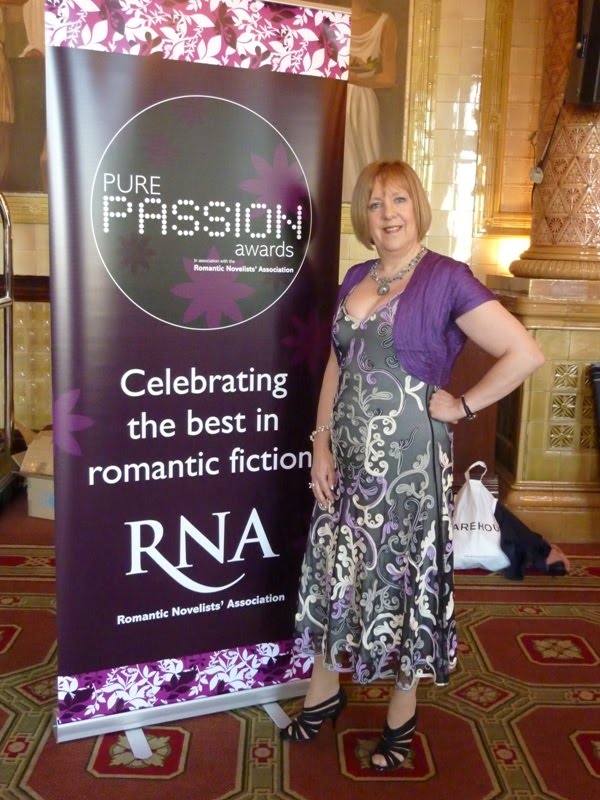




Picture list
Me
1. The winning screen when the Historical Novel of the Year was announced
2 Me, posing by the Pure Passion Poster
3 Me with my agent Carole Blake
4.Me with Carole Blake again - a matching pair in purple!
5. The winning authors with Katie Fforde in sea-green in the middle
6. In the palatial loos with Kate Furnivall and Jane Judd
7. Me and Liz Fenwick
8. Me and Elizabeth Hawksley
Other folks
9. Diane Pearson, Richard Lee and Elizabeth Hawksley, the Historical Prize judges
10. Jan Jones
11. Jan Jones
12. Jane Jackson
13 Val Loh
14. Sarah Duncan and JoJo Moyes
15. Julie Cohen
16. L to R JoJo Moyes, Moira Briggs, Jan Jones, Roger Sanderson, Jill Mansell
17. Joanna Maitland, Christina Courtnay, Sue Moorcroft
18. Christina's shoes!
19. Jo Dickinson, friend and editor at Sphere
20. Penny Jordan receiving her lifetime award
Objects
21
21. The reception room
22. Mural in reception
23. The Gladstone Library, LittleBrown table
24. Chandelier, Gladstone Library
25 and 26. Plates of canapes
27. The Gladstone Library
28. Fabulous staircase
Out-takes
29 Liz Harris
30 Christina Jones (neither of us had had a drink!)
31 Christina Jones and Jill Mansell
Friday, March 11, 2011
Next stop on my blog tour: History undressed.
I have a couple of posts waiting in the wings, but in the meantime, I am still on blog tour for the Sourcebooks publication of To Defy A King. Today I was speaking at History Undressed about Medieval marriage and sexuality.
http://historyundressed.blogspot.com/2011/03/guest-author-elizabeth-chadwick-behind.html
http://historyundressed.blogspot.com/2011/03/guest-author-elizabeth-chadwick-behind.html
Wednesday, March 02, 2011
The Blog Tour next post
Here's the next article I wrote for my blog tour in the USA. Published today at Martha's Bookshelf. http://marthasbookshelf.blogspot.com/2011/03/guest-post-digging-for-gold-choosing.html It's a post all about choosing my subjects.
Tuesday, March 01, 2011
The Blog Tour
Today marks the official USA publication of To Defy A King and I'm on the blog tour circuit on and off for the next month. Okay, blog tours exist to promote the novels, but they're also a chance for an author to add in bits of background information and research that might not otherwise see the light of day. So each time there's a blog published, I'll post the url here.
My first stop off is at The Broken Teepee blog and I've written a post about medieval food - what people ate and how they were governed by the seasons and what was available. Url here if anyone is interested. http://www.brokenteepee.com/2011/03/guest-post-from-elizabeth-chadwick.html
My first stop off is at The Broken Teepee blog and I've written a post about medieval food - what people ate and how they were governed by the seasons and what was available. Url here if anyone is interested. http://www.brokenteepee.com/2011/03/guest-post-from-elizabeth-chadwick.html
Subscribe to:
Posts (Atom)